Showing posts with label maps. Show all posts

The kill of New York is a brook in New England


BRANCH – RUN – FORK – BROOK – KILL – STREAM – BAYOU – SWAMP – SLOUGH – WASH – CAÑADA – ARROYO - RIO 

I came across Derek Watkins' excellent map, showing the distribution across America of different toponyms for 'river', on the Spatial Analysis blog (where James Cheshire has added his own UK version).  It reminded me that I have been meaning for some time to do a post here about Home Ground: Language for an American Landscape, edited by Barry Lopez and Debra Gwartney and compiled by a team of writers between 2002 and 2006.  Robert Macfarlane described this book in a wonderful essay published last year ('A Counter-Desecration Phrasebook'): 'Its ambition was to retrieve, define and organise nearly 1,000 terms and words for specific spects of landscape.  Its ethical presumption was that having a language for natural places is vital for two reasons: because it allows us to speak clearly about such places, and because it allows us to fall into the kind of intimacy with such places which might also go by the name of love or enchantment, and out of which might arise care and good sense.'

So what does Home Ground have to say about these river terms?  For the first one, BRANCH, the reader is referred to FORK and the entry, written by Bill McKibben, describes some of the geographical variation evident in Derek Watkins' map.  Easterners are likely to call forks branches, tributory is used elsewhere, 'and those in west Texas would call smaller forks prongs.'  His example of a 'prong' is the North Prong of the Little Red River Fork in Briscoe County Texas.  RUN, according to Kim Barnes, always denotes movement and 'can refer to any small stream, brook, creek, rivulet, channel, overflow, or swiftly flowing watercourse.'  Early Virginian settlers, naming the landscape, came to think in terms of a hierarchy by size: rivers > creeks > runs.  BROOK needs no explanation, but KILL?  It is the Dutch word for brook and appears in the name of landforms of the Hudson and Deleware Valleys, most famously the Catskill Mountains.  The term is not seen in the lower Hudson Valley, probably because, as Jan DeBlieu explains in Home Ground, the Dutch colony was subsumed into the surrounding English speaking culture after the capture of New Netherland in 1644.

Often the authors of Home Ground include illustrative quotations from American literature, like the 'dark stream shooting along its dismal channel' in Melville's Typee.  Gretel Ehrlich's entry on STREAM describes it as a dynamic force that 'receives, and thus reflects, the abuses that have taken place on the land.'  The next few terms, BAYOU, SWAMP and SLOUGH, sound aything but dynamic.  'The bayous are spaces of open water, sluggish or stagnant' and a slough 'is a narrow stretch of sluggish water in a river channel'. The city of Chicago is built on filled sloughs. The word bayou is derived from the Choctaw word for a small stream, bayuk.  Okefenokee Swamp gets its name from a Creek Indian word meaning 'Land of the Trembling Earth'.  A Harry Crews quote explains why: 'most islands in the swamp - some of them holding hundreds of huge trees growing so thick that their roots are matted and woven as closely as a blanket - actually float on the water; and when a black bear crashes across one of them, the whole thing trembles.'

With the word WASH we move into the American Southwest : Carrizo Wash in Arizona, Hunter's Wash in New Mexico. These are areas of land over which 'subtle contours allow water to flow, or "wash", from elevated to lower zones.'  ARROYO can be used to describe the same general feature, or, more specifically, a steep-walled, flat-bottomed creek.  Either way it is ephemeral, 'carrying water only briefly during such events as spring runoff or the summer monsoons.'  Two more Spanish terms complete the map: RIO and CAÑADA, 'a wetland rich with river reeds'.  The words RIVER and CREEK are also included but, are so common that they have been coloured grey.  Here in Britain, a creek is a saltwater inlet or the estuary of a stream.  In the entry for 'creek' in Home Ground, novelist Charles Frazier explains that the term spread to mean any flow smaller than a river.  'In a few places, though, a distinction was retained.  M. Schele DeVere, in his 1872 Americanisms: The English of the New World, put it succinctly: "The kill of New York is a brook in New England, a run in Virginia and alas! a crick or creek, almost everywhere else."'

Soft pink landscape

Earlier this week I was sad to read Waldemar Januszczak tweet 'Oh no, Richard Hamilton died this morning. That is a HUGE loss. Probably Britain's most important post-war artist.'  But, as he went on to say, 'Richard Hamilton was working on a big touring retrospective when he died. So at least there is that to look forward to.' Back in 1992 I went to a sizable retrospective at the Tate Gallery and have just been re-reading the catalogue. This reminded me that five years before his famous collage, Just What Is It That Makes Today's Homes So Different, So Appealing?, Hamilton was helping to make large map-models of New Towns (Harlow, Basildon and Speke) for the Festival of Britain's Exhibition of Architecture, Town Planning and Building Research.  There is a small black and white photograph of one of these in the catalogue (like a Ghost Box album cover), where it is contrasted with Landscape (1965-6).  This later work is mixed media added to an enlarged postcard image of the South Downs - panoramic landscape as a 'self-reflexive, game-playing switching of representational codes, rather than as a mimetic, miniaturised simulation of the new Socialist Britain.'

In the early sixties Hamilton was struck by a new advertising campaign for Andrex toilet paper that featured photographs of girls posed in a forest glade.  He described the scene: 'Nature is beautiful.  Pink from a morning sun filters through a tissue of autumn leaves.  Golden shafts gleam through the the perforated vaulting of the forest to illuminate a stage set-up for the Sunday supplement voyeur.'  It is a masturbatory fantasy: 'the woodland equipped with every convenience.  A veil of soft-focus vegetation screens the peeper from the sentinel.  Poussin?  Claude?  No, more like Watteau in its magical ambiguity.'  In Soft pink landscape (1971-2) he reproduces this scene in misty paint, as if seen through half-closed eyes, with a roll of Andrex placed on the ground.

In 1975 Hamilton exhibited Andrex-inspired work at the Serpentine Gallery along with other landscape views derived from postcards.  Some of these show Miers, the French spa noted for the laxative properties of its waters.  There were also nine pastel images of sunsets, each with a giant turd in the foreground.  One further view was of sunrise over Cadaqués with a turd blotting out its church, and Hamilton linked this with Jung's account of a dream he had: 'the cathedral, the blue sky, God sits on his throne, high above the world - and an enormous turd falls upon the sparkling new roof, shatters it, and breaks the walls of the cathedral asunder.'  Hamilton's interest in the Andrex adverts continued and in 1980 he completed Soft blue landscape (the cover of the Tate's 1992 exhibition catalogue, below, shows a detail from this painting, omitting the toilet roll).  It was at this point that Hamilton discovered the rather surprising identity of an artist who had actually worked on the original 1960s Andrex campaign... Bridget Riley.

Theoryscapes


Landscape Theory (2008), edited by Rachael Ziady DeLue and James Elkins, is Volume Six in the 'Art Seminar' series, which addresses current issues in writing about art through roundtable discussions and invited contributions.  It is a really rich and readable anthology of writing about landscape; the theory doesn't get too heavy despite the forbidding cover - an empty seminar table rather than a picturesque landscape.  Interestingly, one contributor to the book, Jill H. Casid, noticed the way that the general preface to the whole series, written by Elkins, is actually 'implicated in the discourse of landscape with its rehearsal of what we might call the metaphorics of theoryscaping.  Current writing on the visual arts is compared to a "trackless thicket" in order to assert that it is "not a wilderness."  Instead, visual graphs (that are given the look of geological formations [they are 3D area charts]) convert "theory in art history" into a "landscape of interpretive strategies" through which the series offers a well-blazed and navigable trail.'

I thought it might be interesting here to try to summarise briefly the seminar discussion (70 pages in the book!) and in doing so add links to some relevant earlier posts on this blog.  The event took place in June 2006 at the Burren College of Art in Ireland and brought together art history, geography and landscape architecture academics (plus an independent scholar - Rebecca Solnit).  James Elkins opened the discussion by remarking that in the years since the original publication of Denis Cosgrove's influential Social Formation and Symbolic Landscape (1984), it has become increasingly possible to move beyond the idea of landscape-as-ideology. There was general agreement to this, including from Cosgrove himself, who nonetheless recalled that his book had been a reaction against two then-prevalent ways of thinking about landscape: as the romantic, aesthetic response to nature or as more scientific, geographical analysis. Elkins introduced a third notion, landscape as a work of physical production, leading to discussion of the etymology of 'landscape' - the OED defines it in relation to art but another root is the Old English 'landscipe', which concerns the shaping of a place.  A fourth version of landscape, the representation of space and time ('landscope') provoked discussion of the priviledged position of the observer in art history and those 'timeless' landscapes without figures, like Ansel Adams' photographs of Yosemite.

The problems of separation - either by framing a view or more generally from the unbridgable distance between observer and those actively shaping the landscape - led to the first mention of phenomenology as a way of thinking more about our experience of landscape. Jessica Dubow talked about the recent turn to phenomenology in cultural geography, which has moved beyond the study of images (or images-as-texts) to a more direct encounter where the subject is inside the landscape. There was some further discussion of ideology and whether it is helpful to think of 'landscapes' in the postmodern global cultural economy (Arjun Appadurai's notions of 'finance-scapes', 'techno-scapes' and so on).  But the last words of the morning session were Denis Cosgrove's, concluding that a focus on virtual spaces 'raises issues in relation to the materiality of landscape that phenomenology emphasizes.'

The conversation recommenced with discussion of the extent to which landscape became less central to twentieth century art.  David Hays referred to a different trend in landscape architecture, where art has become less influential: ecological concerns now dominate and 'art' is seen as almost a dirty word (although there are exceptions -  Anne Whiston Spirn mentioned Martha Schwartz's Splice Garden). The discussion then turned to maps, panoramas and their military origins and from map-making to the distinction between cartography, the conceptual visualisation of the landscape, and chorography, a more sensory, descriptive approach.  But in the midst of this I was struck by Denis Cosgrove's comment that 'mapping removes us a little from the suffocating embrace of ecology when thinking about the natural world and places and our relations to them.'  Trenchant stuff - just as well no ecocritics had been invited!  The absence of any ecological discussion in this seminar was interesting to me (since this blog has always focused on forms of landscape art, rather than environmental art) but disappointing too, given the natural expectation that there would be cutting edge theoretical thinking in this area.

At this point in the seminar James Elkins intervened to change the subject and ask whether it is possible to imagine landscapes outside of their representation in art.  The subsequent discussion touched on the way tourists see Yosemite through the lens of Muybridge and Adams, partly because the park's infrastructure leads them to specific viewpoints. These photographs are social acts - people rarely take a view without posing in front of it - but such views are still based (for Elkins) on the late-Romantic Western tradition of painting and photography. This view has been put forward in Joseph Leo Koerner's writings on Friedrich and indeed one participant, Michael Newman, suggested that Friedrich's hyperreal style clearly pre-figures our contemporary digital landscapes. I was surprised there wasn't more exploration at this point of different perspectives, although participants did mention the Silent Traveller books, written in England by Chiang Yee, and the landscape architect Nicholas Brown, who 'walks somewhat in the spirit of Richard Long.'  But time was obviously running short and after a few more questions from the audience Elkins closed the seminar, inviting participants to head out for a hike 'in what we persist in pretending is the actual landscape'.
The Burren landscape

Landscape from Finnmark

This week I popped into the National Gallery to see an interesting new exhibition: 'Forests, Rocks, Torrents: Norwegian and Swiss Landscapes from the Lunde Collection'.  These two countries were in many ways very different in the nineteenth century - Switzerland prosperous, independent and rapidly industrialising, Norway poor, dominated by Denmark and Sweden and dependent on exporting its natural resources.  Swiss artists tended to stay in Switzerland whereas the Norwegians tended to travel. The importance of getting away from the familiar is illustrated in the case of Peder Balke (1804-87) who studied art in Christiania and Stockholm and began his career painting conventional landscapes.  In 1832, as Christopher Ropelle and Sarah Herring write in the catalogue, he travelled by ship to the North Cape, 'a rugged and largely inaccessible area of the country.  There he found bleak and original motifs which allowed him to define his highly individual painting style.  He continued to explore these motifs in increasingly austere images throughout his career.'  The exhibition includes Landscape from Finnmark (about 1860), an icy view across snow-covered rocks to distant grey mountains, dominated by a single tree, leaning at an angle as if battered by the elements.  The painting reproduced below is another of Balke's Finnmark scenes.

Peder Balke, From Hammerfest, 1851

On entering the exhibition, the first thing you see is a large map on the wall, reproduced from an 1873 Baedecker on Switzerland, with pins showing locations of the paintings: The Wetterhorn, Lake Lucerne, the Valley of Lauterbrunnen and so on.  There are also pin maps of Norway, based on Thomas B. Wilson's 'Handy Guide' to the country of 1888.  These reminded me of another thing I've been doing this week: working on the Some Landscapes Timeline and Map.  I am still compiling this so the screenshots below represent work in progress.  The map shows a selection of places connected to my blog posts - I shall now be able to add a little Google pin on Finnmark.  The timeline, similarly, is no more than another way of viewing the blog, but I suppose you could see it as a rather eccentric history of landscape and culture.  So far it stretches from Sargon II's park at Ninevah (715 BCE) to Hamish Fulton's Everest ascent (2009).   Some of the dates relate to paintings or publications but many involve encounters with landscape: Wang Po at the Pavilion of the Prince of T'eng, Dorothy Wordsworth in Scotland, Olivier Messiaen in Utah, and here, Peder Balke in Finnmark. 


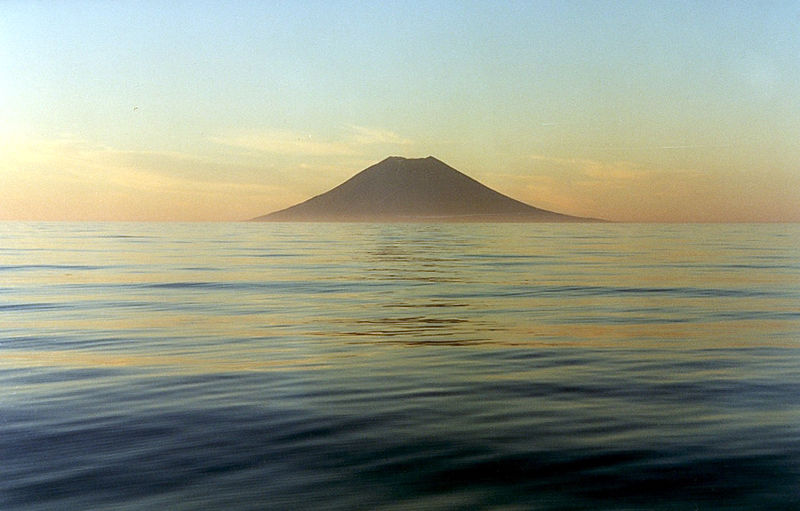
Atlasov Island


I read Judith Schalansky's Atlas of Remote Islands: Fifty Islands I have not visited and never will last month, but keep flicking back through it and looking at the maps.  They are all printed on the same scale and as you can see from the examples above, each island seems to possess a uniquely satisfying shape.  Various reviews will give you the background on this book, which won the German Arts Foundation Prize for the Most Beautiful Book of the Year (a version of which it would be good to have here) - there's an excellent piece about it on John Self's blog, for example, and another by Robert Macfarlane in The Guardian.  The short prose pieces accompanying each map reminded me, as they have others, of Calvino's Invisible Cities. The island of Tikopia, for instance, has 1,200 inhabitants who believe in zero population growth; then there is Pingelap, where a significant minority are colour blind but insist they can see things hidden from the others, like dark shoals of fish in the moonlit sea; and Takuu, where the old people build dykes to combat rising sea levels and the young spend their time drinking the juice of the coconut palm but, either way, 'Takuu will sink - next month, next year...'

Not all the islands are inhabited though, and one I thought I would highlight in this landscape blog is Atlasov Island, known in Japanese as Araido-tō and 'more beautiful than Mount Fuji.'  Apparently haiku have been written in praise of it, but I have not managed to track any down.  Schalansky notes that in the early 1950s a 'women's penal colony was set up', but no one lives there now.  There is a myth that the mountain was forced to move from its original home in the middle of Lake Kurile on the Kamchatka peninsula, where its perfect beauty made the surrounding peaks jealous.  'So it started out on a long journey, finally settling itself down in a peaceful spot far away in the sea. ... The river Ozernaya flows in the tracks of the mountain's reluctant journey.  When the mountain lifted itself from its place, the water of the lake rushed after it.  It is a thin blue umbilical cord that will always bind the exiled mountain to its homeland.'

Atlasov island
Source: Wikimedia Commons