Showing posts with label light. Show all posts

To go out and walk far in the forest

Badelunda, Sweden

I was glad to hear that Tomas Tranströmer has won the Nobel Prize and have been looking today through my copy of his New Collected Poems, translated by Robin Fulton.  Here is my guide to some of the imagery you'll find in his poetry.
    1. Snow.   In an earlier post I talked about a poem, 'From March 1979', in which Tranströmer goes to a snow-covered island and sees in the tracks of the deer 'language but no words.'  Language itself suffers in the still, cold February of another poem, 'Face to Face', where there is deep snow and 'footprints grew old out on the crust. / Under a tarpaulin language pined.'  But the onset of a snowfall can seem as joyful as music ('C Major') and when winter ends eventually, as in the poem 'Noon Thaw', the world has a new language: 'the vowels were blue sky and the consonants were black twigs and the speech was soft over the snow.'
    2. Stillness.   In that dead winter of 'Face to Face', 'living stood still' and 'the soul / chafed against the landscape.'  But eventually, one day, colours flared and 'everything turned around. / The earth and I sprang towards each other'. Elsewhere in Tranströmer there are moments of quiet contemplation, 'Weather Picture' for instance, where the October sea glistens coldly and all sounds are 'in slow flight'.  'Breathing Space July' contains three moments of stillness, lying under a tree, looking into the water, and sleeping.  And in 'Slow Music' he writes of a day down by the water, 'among large stones with peaceful backs', where 'you can stand in the sun with your eyes shut / and feel yourself being slowly blown forward.'
    3. Summer.   In a prose poem, 'The Blue House', Tranströmer stands ina dense forest under 'a night of radiant sun.'  'A ship's engine far away on the water expands the summer-night horizon.  Both joy and sorrow swell in the dew's magnifying glass.'  But those sunlit Swedish summers will eventually fade until the sounds of the forest flow 'into a single melancholy murmer' ('The Cuckoo'). In 'Lament' the writer notices the slow coming of night. 'The moths settle on the window pane: / small pale telegrams from the world.'
    4. Song.   In 'Song' Tranströmer recalls the legend of Väinämöinen, the eternal bard of the Kalevala, riding over the sea.  He also listens at nightfall to the abortive music of gulls on a dark skerry.  You can hear birdsong in many of his poems - 'Ringing', 'Morning Birds', 'Memories Look at Me', 'Early May Stanzas', 'The Nightingale in Badelunda'. The last of these describes a moment when time stopped as he listened to 'the raw resonant notes that whet the night sky's gleaming scythe.' 
    5. Stars.  'Orion hangs above the ground-frost...'; 'Silent constellations.  And the cold ocean.' Tranströmer poems often take place at night, although the stars may merely be glimpsed, up through the grating of winter.  In an early poem, 'Epilogue', he describes the evening star like an X-ray, developing a hidden landscape of houses, trees and fences.  And then a storm comes in and the stars seem to signal for help, 'lit and quenched by headlong clouds / that only when they shade the light betray / their presence.'
    6. Sleep.   In 'Tracks' a train stops in the middle of a plain - 'bright moonlight, few stars' - and far away there are the lights of a town.  It is like a dream that the sleeper will not remember. Sleep and dreams recur throughout Tranströmer's poetry and indeed the opening lines of the first poem in his first collection describe that moment of awakening when 'consciousness can grasp the world / as the hand grips a sun-warmed stone.'  'The Man who Awoke with Singing over the Roofs' evokes that same feeling, when the sleeper 'begins / groping for attention's instruments'. 
    7. Storms.  Sometimes the poet is woken by a storm.  In 'Autumnal Archipelago' he listens in the darkness to 'constellations stamping inside their stalls, high over the tree-tops'.  Similarly, 'A Winter Night' begins with this memorable image: 'the storm put its mouth to the house / and blows to produce a note.'  These experiences suggest a simile in 'Agitated Meditation': 'a storm drives the mill sails wildly round / in the night's darkness, grinding nothing. - You / are kept awake by the same laws...'
    8. Silence.   Other times the nights are quiet: in 'Nocturne', the trees keep 'silence in concord with each other.'  In 'Five Stanzas to Thoreau', Tranströmer talks of silence slowly spiralling from the earth to grow 'with its burgeoning crown to shade his sun-heated doorstep.'  Thus silence seems sought after at times - in 'Along the Radius' he sits by an ice-bound river on an upturned boat 'swallowing the drug of silence'.  But in 'April and Silence' Spring lies desolate and 'the only thing I want to say / glitters out of reach / like the silver / in a pawnbrokers.'
    9. Solitude.   In 'Alone', Tranströmer says 'I must be alone / Ten minutes in the morning / and ten minutes in the evening / without a programme.'  Earlier in this poem he is walking on the frozen fields of Östergötland and doesn't see a single person.  Other solitary artists appear in his poems - Thoreau 'disappearing deep in his inner greenness' and Grieg in his work-cottage, 'shut in with silence.'  In 'Solitary Swedish Houses' everything seems to stand alone and summer comes with 'flaxen-haired rain / or one solitary thunder-cloud / above a barking dog.'
    10. Sunlight.  Finally, the transformative effect of sunlight is evident in poems like 'Landscape with Suns', where the poet takes the memory of a glowing sun back to 'the half dead grey forest /  where we have to work and live.'  'Further In' describes an evening when he is driving through thick traffic.  A low red sun streaming in through his windscreen makes him feel transparent, so that 'writing becomes visible / inside me'.  Right then, he knows he must 'get far away / straight through the city and then / further until it is time to go out / and walk far in the forest.'
      CHAPTER TEN -- NIGHT

      (With thanks to The Pastel Journal, where this chapter was originally published.)


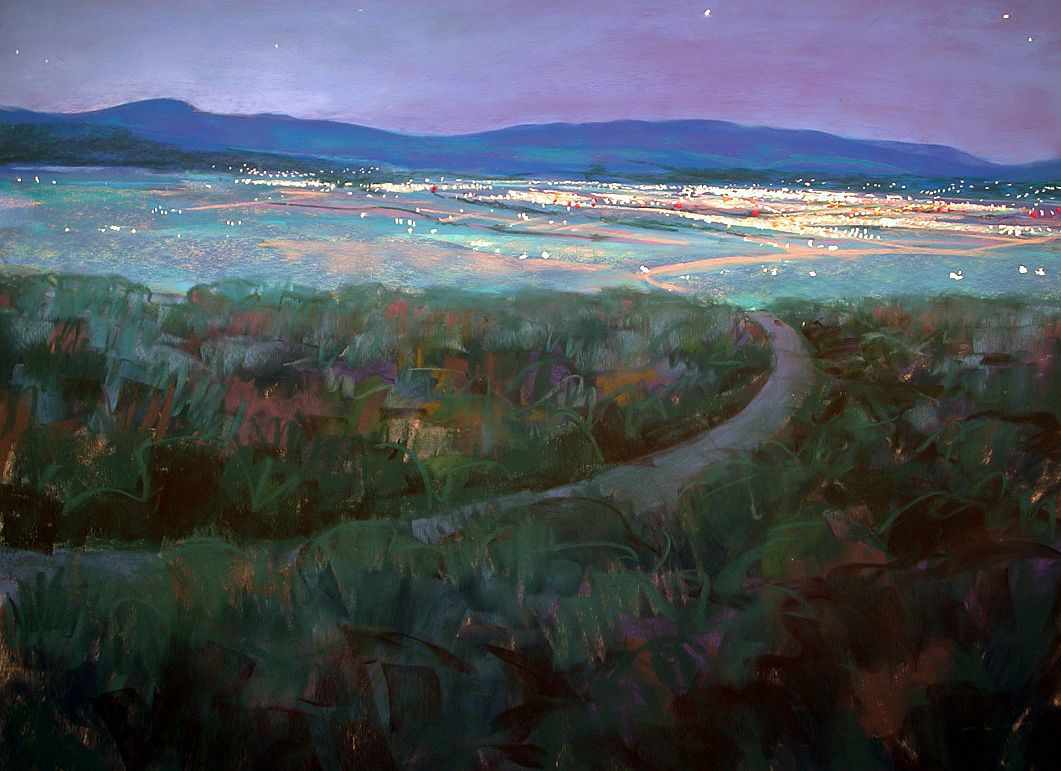
      Nighttime City, 17" x 23"

      Evening scenes intrigue us. Darkened skies allow soft shapes and patterns to emerge from shadows as the eye is drawn to the glimmer of warm lights amid the cool colors of twilight. The night reveals only some details and allows the mind to complete the picture. The subdued light and softness of evening evoke a certain mood in a painting. “In the shadows the mysteries dwell,” mused Leonardo da Vinci. However, in painting the night, darkness is always defined by the light.

      Night paintings are low-key in value and color, often with areas of brilliant light to draw the eye. The use of powerful darks -- deep but colorful -- can strengthen a painting, while areas of light allow vivid medium and light colors to punctuate the dark. The night sky is cool, and headlights or city streetlights interrupt the darkness, unless the moon rises to cast its soft glow over the landscape. A fleeting sunset lends ethereal colors to the sky as the blush of color from the setting sun lingers for a few minutes and the lights of the city begin to twinkle in the distance. Stars and clouds decorate the night sky, setting the mood for the painting. These can be especially vibrant subjects. Night offers different challenges and much beauty to the artist.

      SHIFT IN CONTRAST

      To paint the night it is necessary to shift the contrast of the painting into a quieter mode, allowing the darks to dominate, yet not neglecting the light areas that are the backbone of a nighttime painting. Of course, without light nothing can be seen. No matter what the subject of the painting, it is the light that we must paint.

      The saying, “in the dark all cats are gray,” illustrates the problem one encounters. In the dark, the sensitive cells of our eyes become less responsive to color and we rely far more on value-related black-and-white vision. This is the reason we have trouble finding two socks of the same color in the early morning light of the bedroom, unless the choice is solely of black or white. In dim light color becomes muted and dull, intensity is subdued and all colors take on a slightly grayish cast. However, this graying and dulling of colors in the dark is what allows the intensity of light to work in a painting. The blaze of light attracts the eye and reveals the colors.

      So how can we make interesting and lively paintings of the evening? First we must change the value range in the piece. Instead of relying on the usual dark, medium and light scale of a normal daytime scene when the daylight is creating many medium values throughout the painting, we use a narrower range of dark and light only. The medium values and colors become much less visible except where there is light cast on the subject. Everything in the dark stays fairly dark and only those things in the path of the light are bright in color. This higher contrast of dark and light can make a strong painting.

      USING STRONG DARKS

      The majority of colors used in a night painting will be dark, so begin there. Use a variety of subdued shades, layering them together to form fascinating colors that are interesting and deep.

      Do not depend on black for the dark areas. Although black may be layered beneath colors to achieve the desired shade, it tends to be a cold, stark color when used alone. Vincent van Gogh once wrote about his painting titled Café Terrace, ". . . here there is a night picture without any black, nothing but beautiful blue and violet and green, and in those surroundings the lighted square is colored sulphur yellow and limey green.” As van Gogh did, use beautiful colors -- deep, dark blue, green, purple or red -- layered over black or atop another to make pleasing and vibrant darks.

      Your colors need not all be cool, though most will likely contain some cool notes. Remember that your nighttime painting will utilize a lot of dark colors, so work to make them a strong portion of the piece, whether warm or cool.

      Spend time outside at night observing how much color you can see. Notice the fascinating darks and how they are made distinct by light. Look for the colors you might use to make a painting -- dark and light. See how medium values exist only in well-lighted areas, and note that streetlights have a slight halo around them in the dark.

      Night Street, 12" x 9"
      USING STRONG LIGHT

      Areas of light can occur as pinpoints in a night scene, such as streetlights or car headlights, or as a broad pane of light in the window of a house, so it is necessary to carefully compose using them. It is easy to end up with a piece that looks spotty, with points of light scattered in a disjointed way across the painting. Design with the thought of how the viewer’s eye will move through the piece.

      Remember that the area where the lightest light and the darkest dark come closest together will draw the eye first and become the focal point of the piece. Sometimes in a dark painting the largest area of light will become the focal point, such as a large window where the light pours out. Be sure in either of these cases that the visual pathway formed by any other points of light compliment and reinforce this focal point, rather than draw the eye away.

      Light areas in a night painting are the perfect place to use exciting colors, such as the sulphur yellow and lime green of the lighted square in van Gogh’s painting. The contrast of dark surrounding the light accentuates it, making it a special feature of your painting. Different kinds of bulbs cast light of varying hues. Incandescent bulbs are warm and yellowish, fluorescent light is generally cool and neon light is intense.

      All bright lights at night have a slight halo, a softening of the edges where the light seems to hang in the air. The night air is somewhat moist and this vapor holds the light inside it. The larger the light and the wetter the night, the bigger the halo tends to be. Technically, you can achieve this effect by saving an area in the dark plane where the light will be, then laying in a medium color, perhaps a red, and blending it slightly into the surrounding darkness. Then add a layer of a medium-light color, depending on the color of the light itself, and allow the color beneath to show at the edges. A final touch of the lightest color in the center, usually very light yellow or white, simulates the brilliance of the light shining in the darkness.

      THE NIGHT SKY

      Theoretically the night sky, when it is without the moon, stars or clouds, is a velvety deep black. Once again, flat black is not your best choice. Try using deep purple, dark blue and black, even adding a touch of the darkest green to the mix. Starlight can add a touch of violet to the darkest sky.

      Even at night the sky is still slightly lighter in value compared to the darkened land plane, though it will not be the lightest value in the painting if there is a light source showing. The evening sky appears somewhat lighter than you think, especially in the early twilight. Carefully choose the value of the night sky, using colors from the cool side of your palette.

      The night sky has a cool cast to it. No matter what color you decide to use, all colors are flavored with a bluish tone. At sundown, make yellows slightly green, pinks somewhat violet and greens bluer in hue. Remember that the darkest colors are at the top of the sky, highlighted by sunlit clouds beneath or punctuated with evening stars.

      Let the glow of sprawling city lights in the distance, or the radiance of the soon-to-rise moon, illuminate the sky a bit, revealing mountains, hills, houses or trees in silhouette. The radiance of a mass of city lights can brighten the night sky to almost daylight proportions. Structure this kind of painting so that darkness hangs between the buildings, allowing the lights to shine brightly.

      Night Overlook, 9" x 12"
      THE MOON, STARS AND CLOUDS

      The moon can be a delightful addition to the night sky in your painting, though its brilliance against a velvety dark sky can be arresting. Early in its trip across the sky, the moon can appear quite large and very yellow because of the magnifying effect of the atmosphere on it as it rises. When painting this, be sure that the high contrast of the light moon and dark sky contributes to the composition without becoming distracting.

      Moonlight, even when the moon itself is not included in the picture plane, can define the characteristics of the landscape, describing hillsides, trees or buildings. Contours and shapes emerge from the darkness, muted by the night, cool in color, but still describing forms. Sometimes moonlight will be reflected off of particularly light objects and cast a secondary shadow. Look for light bouncing from a white building or wall and casting a deep shadow behind the foliage next to it. In deepest dark such secondary shadows do not exist.

      A starlit sky may be a velvety dark violet or may softly glow dark purple with pinpricks of light floating in it. Use soft pastels in medium-light colors for the majority of stars, reserving the lightest color for the brightest stars. Remember that the light from the stars has traveled a great distance and is not the lightest light in the painting. When painting stars it’s best to keep in mind that fewer stars add more visual impact.

      Clouds can add a blush of color in a moonlit sky, sometimes iridescent as mother-of-pearl, sometimes warm or cool gray. They serve to soften the shine of the moon and lend mood to a painting. They can foil the brightness of the sky, focusing the eye on the land plane instead.
      Night's Colors, 9" x 9"
      SUNSET SKIES AND CITY LIGHTS

      Sunset skies, when the atmosphere is alive with a blush of color for a few minutes, can add interest and sparkle to your paintings. The light level has diminished enough that the value contrast is reduced, adding the chance for city lights shining against the medium-dark colors of the land.

      The darkening sky is very bright at the horizon as the sun dips below the land plane and the angle of the light is increased. The zenith of the sky may be dark enough that, even as the sun sets, there are stars beginning to sparkle overhead.

      City lights in the distance can be a particularly interesting subject to paint. Observe such lights carefully, noticing how streets lined with stoplights, brake lights and headlights line up to form yellow or red streaks. Study how the sizes of the points of light indicate distance, the smaller pinpoints farther away. Look for red and white lights on the tops of hills or buildings, at the highest point. Indicate the sprawl of the city and the interruption of the hills, mountains or rivers with the pattern of lights. Include trees and other foliage amid the lights, which helps to illustrate the contours of the land. Add touches of red, green, yellow or orange from business signs, taillights and neon signs.

      Night paintings can be a delightful challenge to paint. The contrast of the somber and the spectacular can be captivating, giving you endless opportunities for paintings. From city scenes to moonlit night skies, to the starry sky decorated with clouds, keep the mystery and mood of night paintings in mind and let the light define the darkness.


      San Diego Fires, 9" x 12"