Showing posts with label lakes. Show all posts

Two Years at Sea

Ben Rivers' first feature film Two Years at Sea (2011) follows the solitary life of Jake Williams in his ramshackle house in the woods of Aberdeenshire.  It has a wonderful landscape sequence where Jake floats slowly across the frame on a home-made raft.  The film was shot using reclaimed 16mm Bolex cameras on Kodak Plus-X (which, if I remember rightly, was what Grant Gee used in Patience: After Sebald) and processed in the film-maker's own kitchen.  This film stock seems to add extra layers of fog to the low hills and fir trees.  Watching it on Friday, I was conscious at one point that I was seeing a view successively filtered through faling rain, a car windscreen, an old camera lens being shaken around as Jake drove up a track, and the grainy black and white film itself, hand-processed and then re-projected onto the cinema screen. The Q&A session after this London Film Festival screening revealed the extent to which the film constructs its own version of the real Jake.  Jake himself was there answering questions, dispelling some of the films' mysteries and revealing the extent to which it was a collaboration: the raft idea, for example, had been a long-standing idea of Jake's but it was the presence of the camera that prompted him to construct it and paddle out onto that grey, misty lake.

Image from David Bordwell's site.

The Jack Pine

Painting Canada: Tom Thomson and the Group of Seven is another superb exhibition at Dulwich Picture Gallery, following others I've described on this blog: Salvator Rosa, Paul Nash, Adam Elsheimer.  Reviewers (like Brian Sewell) will inevitably have to provide some background information on the Group of Seven, whose work has not often been seen in the UK.  In Canada, as Ian A. C. Dejardin says in the catalogue, their work has been endlessly discussed 'to the point of exhaustion.  Yet their visual legacy remains supremely powerful: many Canadians, raised with reproductions of the Group of Seven's most famous paintings on their classroom walls, still see their own country through the Group's eyes ... Few of us in Europe could point more than vaguely on a map to any of the locations these artists depicted.  These are painted woods, trees, lakes and mountains only.  Nonetheless, non-Canadians should be aware: we are on holy ground.'  As I know some readers of this blog are Canadian (see comments on my last post...) I'd better admit that a lot of these paintings were completely new to me.  

Tom Thomson in Algonquin Provincial Park, 1914-16
Source (all images here): Wikimedia Commons 

At the start of the exhibition, there is a quotation from Fred Housser, who wrote the first book about the Group of Seven in 1926: "This task [of expressing the spirit of the Canadian landscape in paint] demands a new type of artist; one who divests himself of the velvet coat and flowing tie of his caste, puts on the outfit of the bushwacker and prospector; closes with his environment; paddles, portages and makes camp; sleeps in the out-of-doors under the stars; climbs mountains with his sketch box on his back."  The idea of an artist who 'closes with the environment' reminds me of recent British land artists who have walked in Algonquin Park and other landscapes explored by the Group of Seven.


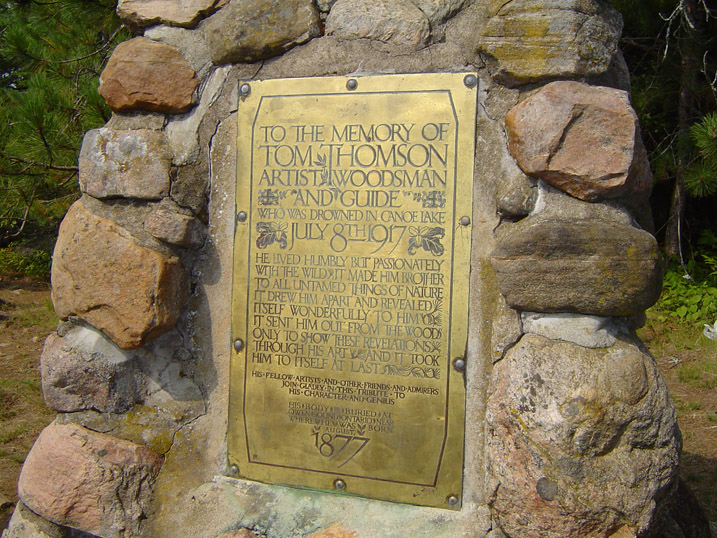
When Tom Thomson died in 1917, his memorial described him as 'artist woodsman and guide'.  Photographs show him fishing and canoeing; one of these was the basis for Peter Doig's White Canoe (1992) (see also my earlier post on Doig's Figure in a Mountain Landscape paintings).  However, as Dejardin points out in the catalogue, Thomson was actually rather a snappy dresser when out and about in Toronto and he made a point of adding some expensive cobalt blue to the marine grey used in painting his canoe.  In 1919 the wealthiest of the group, Lawren Harris, had a boxcar fitted out as a travelling studio for a trip north on the Algoma Central Railway.  It sounds more comfortable than the floating studios of the Impressionists, but this didn't detain some of the artists: as A. Y. Jackson observed, sitting in the boxcar, 'the other chaps are all out sketching under umbrellas.  They are all trying to turn out four a day and can't stop if it rains.'

 Tom Thomson, The Jack Pine, 1916

Tom Thomson's most famous paintings, The Jack Pine and The West Wind, are shown alongside their original sketches in the exhibition's first room.  Each is a majestic landscape visible behind the drooping form of a pine tree, its branches seemingly surrounded by a faint aura.  Pine trees seem to have inspired poets and artists all over the world so it seems surprising in retrospect that (according to Housser) the Canadian artistic establishment, unable to see beyond European and Hudson River landscape visions, considered their native Jack Pine trees unpaintable before Thomson came along.  There is a Pine Island in Georgian Bay (part of Lake Huron) and this exhibition includes two 1914 sketches of it by Thomson and a night scene by Jackson, where the trees stand over a pool of deep blue in which you can see the reflections of stars.
 
Six of the Group of Seven, plus their friend Barker Fairley, in 1920
From left to right: Frederick Varley, A. Y. Jackson, Lawren Harris,
Fairley, Frank Johnston, Arthur Lismer, and J. E. H. MacDonald.

In 1925 a critic noted that the Group had been 'tree mad', but also, successively, 'lake-lunatic, river-ridden, birch-bedlamed, aspen addled, and rock-cracked.  This year they are mountain mad.'  The exhibition's room of mountain views includes Frederick Varley's Hodleresque The Cloud, Red Mountain (1927-8) and Lawren Harris's stylised, almost art deco Mt Lefroy (1930), although I preferred the more direct, less abstract approach of J. E. H. MacDonald, especially a view of a small turquoise lake in the gathering snow with the Japanese-sounding title, Mountain Solitude (Lake Oesa) (1932).  The final room collects more of Harris's Theosophically-inspired landscapes from the late twenties - radically simplified mountains and ice bergs under grey skies, sometimes parted with shafts of light, reflecting his search for those 'moments in the North when the outward aspect of nature becomes for a while full luminous to her informing spirit - and man, nature and spirit are one.'

At the Loch of the Green Corrie

Andrew Greig is a Scottish novelist, poet and mountaineering writer who I think I first read in Alec Finlay's anthology The Way to Cold Mountain (2001).  There he had a short prose piece called 'By the Loch of the Green Corrie' about a quest to find and fish in the loch that the poet Norman MacCaig (1910-96) had considered his favourite spot in the world.   The loch's location is revealed by an old friend of MacCaig and Grieg then heads off, accompanied by two friends (better fishermen than he) to try to find it.  'It's a gem all right.  Yes, green rough grass and screeds of grey scree.  Held in a bowl, secluded, quiet, its own world.  Quinag in the distance.  Nothing else.'  They fish all day but get no catches.  The mist comes in.  'Sounds of water, wind over grass, occasional shrill keek of a lone bird of prey.  The Loch of the Green Corrie began to sink into me.'  They stay for another day but still no luck. They pack up and leave.  'We're grubby, fish-free but feeling very alive, in touch, refreshed.  The homage is done, for this year.'


'The slope opposite rises like a breaking frozen wave of grey and green' 
Screen dump showing my own attempt to locate the Loch of the Green Corrie, whilst sitting here using Google Earth

A book-length homage, expanded from this original essay, appeared last year, the centenary of MacCaig's birth.  The account of the fishing trip is fuller and longer, with the addition of an extra day and digressions on poetry, geology, land-ownership and the right way to live.  I felt quite envious, never having myself camped out in the Highlands or experienced a Hemingwayesque fishing holiday (or even, come to think of it, met anyone who owns a fishing rod), but I did smile to myself when the trip ended with the three friends abandoning their tents to head off for some posh hotel food.  There they raise a glass to MacCaig, whose own poems and observations on the landscape are scattered through this book.  In 'Descent from the Green Corrie', for example, MacCaig describes the walk down 'on screes or boggy asphodel. / And the elation that for a moment fills you / Beside the misty cairn's that lesser thing, / A memory of it.'


The book ends with an account of Andrew Greig's return to the area in 2008, to interview some of Norman MacCaig's surviving friends and have one more go at catching the fish.  Again he spends hours there, until the far side of the corrie begins to lose colour and 'a pale spiral swirls and flattens, coming this way.  A rattling sound, then in a drenching blow the hail squall hits.'  So he leaves empty handed, but on his way home manages at last to catch a fish, in a loch of his own choosing.  And there the book ends, although Greig was back again last year, this time with Billy Connolly, fiddler Aly Bain and a BBC film crew.  A brief clip shows it to have been extremely bracing weather; after a massive overnight snowstorm Connolly is trying to put a fly on his rod and is heard to complain "Could Norman no'like Jamaica or something?"

Before the melt-waters


My copy of The Oxford Companion to the Literature of Wales has a landscape by David Jones on the cover, painted in the twenties when he went to live with Eric Gill and others at Capel-y-ffin in the Black Mountains.  The book describes Jones' long poem The Anathemata (1952) as 'at once devotional and commemorative, a celebration of Christian mysteries and a recalling of the making - both geological and cultural - of Britain ... The poem draws its material mainly from Celtic, Latin and Teutonic 'deposits' underlying London and Wales, and from English literature.'  Peter Ackroyd and Iain Sinclair have followed a similar path in their recent writings (London Orbital quotes 'The Lady of the Pool' section of The Anathemata, in which Jones uncovers the mythic strata of the City).  But before the poem reaches London, before following the waves of ship-borne settlers whose culture has shaped Britain, there is a section called 'Rite and Fore-Time' which describes the formation of the land itself.  What I like about these lines is the way they too contain 'Celtic, Latin and Teutonic 'deposits'', projected back onto Ice Age Britain, 'before the melt-waters / had drumlin-dammed a high hill-water for the water-maid / to lave her maiden hair.'

He says for example, that it is long ages since these melt-waters 'troughed, in solid Ordovician / his Bala bed for Tacitus. / Long, long ago they'd turned the flow about. / But had they as yet morained / where holy Deva's entry is? / Or pebbled his mere, where / still the Parthenos / she makes her devious exit?' A footnote explains some of these etymological references: Bala is also called Pimblemere, and in Welsh, Llyn Tegid, the Lake of Tacitus.  Jones adds that 'it may be noted that Tacitus was the name of Cunedda's great grandfather' (the kind of fact that these days we can find instantly and then pursue as far as we like).  He also explains in the footnote that the lake 'is formed of solid rock but the S. W. end at least is thought to have been influenced by morainic deposits.  At some remote geological period the outflow was southward whereas now the Dee flows northward through the lake, but, says immemorial tradition, the two waters never mingle.'


Lake Bala

The poem goes on to describe the movement south of glacial material, 'heaped amorphous / out of Caledonia / into Cambria.' It was from the Southern Uplands, Jones notes, that 'geological deposits of the Ice Age and certain legendary and historical deposits of the sub-Roman age came to Wales.'  At the same time ice sheets from Ireland, Scotland and the Lake District converged into the depression of the Irish Sea and moved south, 'part thrust against the land mass of North Wales' (here Jones' footnote quotes Brit. Reg. Geol. N. Wales pp77-8).  Microgranites and clay-bonded erratics were wrenched away and carried 'with what was harrowed-out in via, up, from the long drowned out-crops, under, coalesced and southed by the North Channel.'  And then the description of glacial action ends with the strange image of St Brendan on his sea horse.  A footnote explains that glaciation extended 'just beyond the waters between South Wales and Ireland, which very many millenia later became associated with the marvel-voyages of the Celtic ascetics; such as the navigation-saint, Brendan, who in the legend rides the narrow channel on a marine creature and hails Finbar, mounted on David's swimming horse, with the words 'God is marvellous in his saints.''

The region appeared to be smiling

Robert Walser's novel The Assistant (1908) opens on a spring morning as Joseph Marti knocks on the door of a lakeside villa owned by his new employer, the inventor Carl Tobler, and ends the following winter with his departure, leaving Tobler's family mired in debt and contemplating the inevitable sale of their property. In the afterword to her translation Susan Bernofsky says that the book's last paragraph was trimmed before publication, but that the original ending encapsulates 'the mood of the book's final pages in a poignant vignette in which the landscape that has been granted such powers of expression throughout the novel appears as lost in thought as its observer.'  Joseph looks back at the house one more time, 'silent in wintry isolation ... The landscape appeared to have eyes, and it appeared to be closing them, filled utterly with peace, in order to reflect.  Yes, everything appeared a bit pensive.  All the surrounding colors appeared to be gently and sweetly dreaming.'


The landscape's 'powers of expression' are evident almost every time Joseph leaves the workshop and experiences the natural beauty around him.  These exaggerated examples of the pathetic fallacy read as the imaginative projections of a lonely young man, unsure of his place in this world and witnessing the hopes of his employer sinking into inevitable failure. 'Yes, you tell yourself, colors like this produce warmth!  The region appeared to be smiling, the sky seemed to have been made happy by its own appearance, it appeared to be the scent and substance and the dear meaning of this smiling of land and lake.  How all these things could just lie there, radiant and still.  If you gazed out over the surface of the lake, you felt - and you didn't even have to be an assistant for this - as if you were being addressed with friendly, agreeable words.'

Joseph stays on at the villa despite not receiving his salary, unable to bring himself to leave.  But, he reflects, nature itself never really changes - lakes do not suddenly transform themselves into clouds.  'A wintry image could superimpose itself upon the world of summer; winter could give way to spring, but the face of the earth remained the same.  It put on masks and took them off again, it wrinkled and cleared its huge beautiful brow, it smiled or looked angry, but remained always the same.  It was a great lover of make-up, it painted its face now more brightly, now in paler hues, now it was glowing, now pallid, never quite what it had been before, constantly it was changing a little, and yet remained always vividly and restlessly the same.  It sent lightning bolts flashing from its eyes and rumbled the thunder with its powerful lungs, it wept the rain down in streams and let the clean, glittering snow come smiling from its lips, but in the features and lineaments of its face, little change could be discerned.'

As time passes and autumn turns to winter Joseph still sees nature in benevolent terms, as the countryside 'peacefully and languorously allowed itself to be covered with thickly falling snow, calmly holding out, as it were, its large, broad, old and wide hand to catch everything.'  The last day of the year is unseasonably sunny, reminding him of the time in May when he first arrived at the villa.  The weather 'simultaneously calmed and agitated him', but as evening comes - the last evening he will spend there with the Toblers - Joseph, in 'an almost holy mood' goes for a walk. 'The entire landscape appeared to him to be praying, so invitingly, with all its faint, muted earthen hues.  The green of the meadows was smiling out from beneath the snow, which the sun had broken into white islands and patches'.