Showing posts with label aerial perspective. Show all posts

CHAPTER FOURTEEN -- ROCKS

(With thanks to The Pastel Journal where this was originally published.)


Rocks and Oaks, 9" x 12"


The world is made of rock, the substance beneath our feet. From the top of the highest peak, across the bottom of the ocean, to the quiet expanse of the desert, rock is the underlying foundation of all. In our haste to paint our surroundings we mustn’t neglect rock, yet people seem to think that rocks are difficult to paint. Many times I’ve heard students lament that their rocks look like baked potatoes or soft ice cream. The cure for such problems lies in selecting rocks that are interesting and have sharp light and shadows on them.

Pick up a rock and hold it in your hand for a few moments. Explore the surface, searching for spots that are coarse and uneven, perhaps interrupted by bumps and holes. Now feel for the smoother areas, sliding your finger around a corner. This may be a piece of sandstone that has been smoothed to a velvety sheen by the action of a stream. It could be a piece of quartz, softly polished to a hazy white as it rolled in the surf. Perhaps it’s lava rock with uneven holes all over its surface, or a chunk of pumice so full of air pockets it floats. Your rock may have been blown by wind, sandblasted to a soft roundness or broken from a larger rock, resulting in a jagged edge. The many colors and shapes of rocks, sometimes adorned with lichen or leaves, offer a solid underpinning that stands in sharp contrast to the supple surroundings of the earth. Whether the angular facets and sharp fractures of granite or the soft rounded shapes of sandstone, the unmoving weight and unyielding hardness of rock must be made clear to your viewer.

To create believable rocks, you must study the characteristic shapes and fractures of the many differing varieties, analyzing their size and texture, fracture patterns and other distinguishing features. Becoming familiar with rocks typical of the area in which you are painting is essential. You might remember the three classifications of rock: sedimentary, igneous and metamorphic. Fashioned in layers, sedimentary rock is made when deposits of various materials are trapped and slowly compressed over time. Igneous, or “fire-formed,” rocks are created when the molten core of magma is extruded through a vent in the earth’s crust or blasted from a volcano and suddenly cooled. Metamorphic rock has been transformed by pressure, heat and water, changing the crystalline structure of the rock itself.

All rocks are shaped by pressure, temperature, erosion and friction. Most notable is the wind that blows dust and sand, smoothing and sculpting rock; the falling rain, flowing water and crashing waves that tumble and carve rock; the scorching heat and sub-zero cold that stress and crack it; and the tremendous forces of rock sliding over rock that pares it away with the ever-present pressure of the earth itself. Time and gravity move and change rocks. They’re slowly pushed up into mountains or sifted down riverbeds and gradually ground away, becoming smaller and smaller. We don’t sense this change because it happens so slowly. Rocks seem stable, constant, firm. It’s this seeming permanence that must first be communicated.

Look for the special way that rocks relate to one another, whether the rocky face of a sheer precipice or a pile of loose boulders that have tumbled together. The weight of rocks causes them to fall to the lowest point possible, often leaning into or on top of one another. Even the rocky faces of a mountainside lean together as one giant cliff, made up of many facets, most often slightly receding as they climb upward. Smaller stones are then slowly sifted into crevices or between and around boulders, creating more visually engaging complexity.


Primary to a successful painting of rocks is some compositional center of interest, perhaps a cluster of appealing shapes accented by strong light and shadow. A pile of dull rocks with dull light on them hardly inspires the artist or the viewer. Search out an interesting outcrop of rocks in your area. This may not be a dramatic scene. It could simply be some rocks in your garden or a few boulders along the road. Photograph and sketch your rocks at different times of day, returning to see how the colors and contrasts change. Note the time of day when sun and shadows are attractive. Familiarize yourself with these particular rocks, learning the intricacies of clefts and the broad swaths of uninterrupted planes.

A shadow crossing over and around a rock more clearly defines its shape as rounded or flat, bulging or smooth. Creeping into fissures and sweeping over planes, shadows often pick out broad niches, rough textures, cracks and other variations that identify these as rocks -- and not as a pile of mashed potatoes. In contrast, mashed potatoes are soft and rounded, with few distinct planes. True, there are rounded rocks, some that even resemble mashed potatoes, but it’s the job of the artist to communicate the hard, unyielding qualities of even these atypical rocks. More often you will paint those that are far more recognizably rocky rocks.

underdrawing, reclaimed Wallis, charcoal
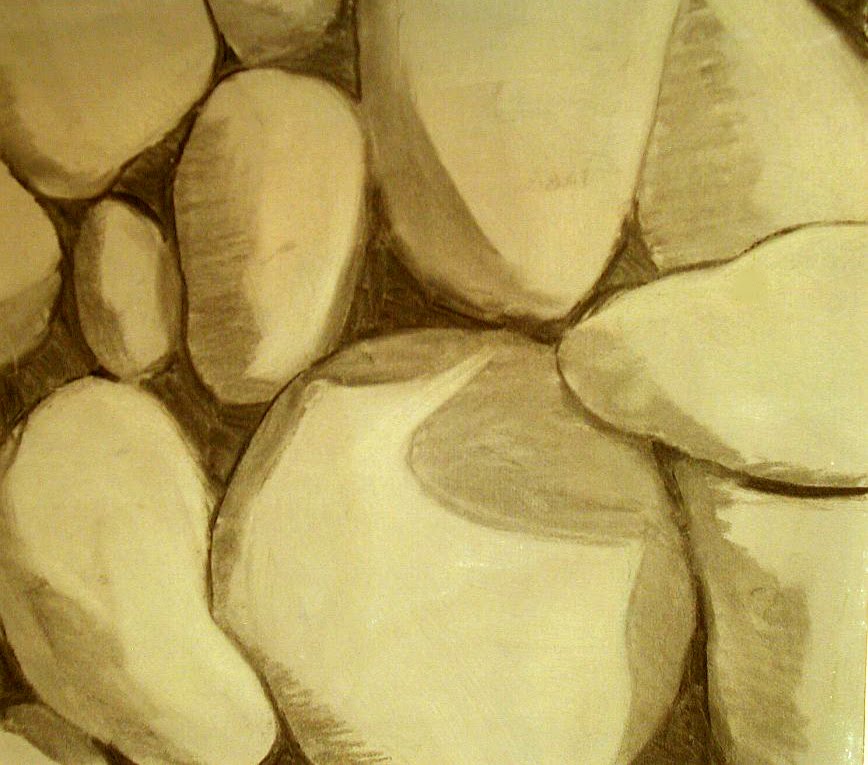
Begin with an accurate rendering of your rocks. If you need to take on the challenge of painting rocks, spend some time looking at, photographing and drawing them. Do an underdrawing or a complete sketch on a separate piece of paper that clearly shows the various planes and details of your rocks before beginning to paint them.

If there’s one aspect that’s key to rendering rocks believably, it’s finding and identifying the planes. Locate three primary planes: dark, medium and light. Where the light strikes most strongly, assign the lightest values. Then select a medium value for the half-light areas, and mark the darkest areas of value where deep shadows occur.

Mass together these value areas into pleasing shapes, perhaps rearranging the rocks in your drawing so that the planes are more clearly indicated. There may be additional values between those you’re using, but simplifying helps distill shapes to their essence. Remember that, generally, light values seem to expand while dark values visually contract, meaning that you may design your drawing using more darks and yet retain a sense of balance.

Observe the colors in each value plane. Most often sunlight bleaches out strong colors, leaving a pale, somewhat washed-out hue. In the shade, rocks are somber and dark, usually lacking in vibrant colors. It’s in the middle tones of the half-light areas that you’ll find the most stimulating colors, depending on the rocks you observe. Think about the colors of rocks in general. Yes, most of us think of gray or beige, which are not inaccurate descriptions. Yet how interested are you in painting a pile of gray rocks? Spend time looking for rocks that have more attractive color, or, better still, challenge yourself to paint admittedly gray rocks using some exciting colors in the proper value range. For instance, in the sunlit area choose pale yellow, pink or peach. In the half-lights use a deeper gold, red or orange, and in the shaded areas use dark brown, maroon or ginger. This can result in rocks that retain their identifying characteristic color yet have spark and appeal to them.

Different rocks are different colors. Consider the great variety of colors found in marble, or the contrasts of sandstone, granite and quartz. Group together a handful of small stones and admire their differing hues, perhaps varying from pink to orange to green. Observe the translucency of one or the striations in another. Notice how they show evidence of wear, some tumbled and smooth, others broken and grainy, and how those diverse textures reflect light differently. See how the colors bounce around in the sunlight, perhaps the glow of a light-colored one feeding into the shadow of its neighbor, making a secondary color that’s a fiery mixture of the two. Studying simple stones can teach you a lot about painting rocks, which can be worthy of painting alone.

It’s best to use a common color throughout the dark, medium and light planes to identify a rock as being made up of a single material. If you select a purple for the shadowed side, be sure to include lavender in the sunlit side. You most certainly will want to layer various colors of the correct value into and over the purples, creating an exciting depth of color, but don’t neglect the identifying color in all the areas of value. Be careful not to paint a rock that’s yellow in sunlight blue on the shadow side and red in the half-light areas or it won’t look like it’s made of the same material. You may choose to contrast colors of various rocks by placing them next to one another, emphasizing the disparity of color or value. For instance, place a purple-hued rock next to one that‘s mainly yellow, or a pale one next to a dark one. To identify a common kind of rock throughout the landscape, utilize repeated colors while retaining a “mother” color, a matrix that defines all the rocks as consisting of the same basic material. For instance, to create the multiple hues found in the Painted Desert choose a mother color, perhaps light rust or dusty pink, and create the muted yellows, reds, oranges and lavenders of the various striations by lightly layering the mother color beneath or on top of all of them.

Shadows can become one of the most fascinating and mysterious portions of your rock painting. Don’t abandoning the dark crevices to a simple line of black. Instead, add deep rich tones of blue, purple or brown. Let the dark planes become lush jewel tones: opulent gold, deep violet, sumptuous maroon and extravagant blue. Darken only the very deepest cracks with an underlying touch of black to heighten the drama there.


Cold River Runoff, 10" x 24"


Standing Sentinels, 18" x 24"

Often rocks are exposed along streambeds and brooks, where the water has cut away otherwise dense foliage. Stony streams abound, though other, similar rocks may lie beneath nearby earth that has not otherwise been disturbed. In rivers the rocks are tumbled and carried along by the action of the water, carved away to show graveled outcrops, ridges and ledges. The action of the water over time has shoved them into relationships with one another, resting together in counterbalanced clusters that resist the never-ending motion. Look for the places where such relationships are clearly seen, perhaps where the boulders and stones lean into one another, surrounded by swirling water. Wet rocks can be exquisitely beautiful. Submerged rocks glisten like multicolored gems. Even rocks that are splashed by a stream show spectacular colors where they’re wet, darker in value and richer in saturation, in contrast to the slightly duller colors and paler values of the dry portions. Again, be careful to retain the overall sense of one color flavoring rocks that are both wet and dry, shifting the values and brilliance of the colors only.

Details can enhance your painting of rocks. The half-light area is generally the plane where most of the details reside. Use lines to draw the eye to a gap or fissure, texturing the surface to make it appear rocky. Don’t over-detail all the planes of the rock, which will destroy the illusion of light and shade. Remember that bright, direct sunlight washes away details in its glare, much like an underexposed photo, just as darkness does in an overexposed one.

Use soft strokes of green foliage to enhance the bold angularity of rocks. The generally warmer colors of stones contrast pleasingly with the cool colors of grasses, bushes and overhanging trees. Even in the parched desert, where rocks prevail, a touch of green refreshes and focuses the eye, pointing to an area of particular consideration.

Rock Pool, 9" x 12"
Study the distinctions of rocks while noting their similarities. Like people, rocks share common characteristics while remaining unique. Enjoy the disparity but search out those universal elements that will help you speak clearly of rocks in your paintings. Find the angular planes that identify this as a rock, distilled to three values to begin. Choose a common color, from light to dark, to create the illusion of one material in all of the value areas, while adding beauty with layers of colors and details that indicate the individual character of this stone. Keep the interest in the half-light areas, where color and detail most often reside. Stop and look at a rock in the same way you might examine a person’s face, appreciating its distinctive beauty.

ROCKY CLIFFS

Painting rock cliffs involves the same rules for painting rocks in general, but in a larger upright plane. To visualize the rules mentioned here, think of the rock faces in a canyon, such as those you find in the Grand Canyon.

As always, I recommend you do a good underdrawing in charcoal on the toned sandpaper, sorting out all the planes of the rock. Find the relationships of the cliffs, how they run into one another and change angles, how the details of light and shadow show depth.

A Place for Gold, 18" x 24"
Start with three values. Find those rocks that are darkest and be sure to get them in place, then look for the medium values, usually where the most color will reside. The lightest values may have to be implied or drawn in with a lighter pastel pencil if you are starting on a dark-colored ground. Be sure you understand where all the various planes of the rocks lie. Look for characteristic fractures, striations and places where wind has worn the rock smooth. Draw in any holes, caves or hollows using light and shadow to indicate them. Draw stains and chelation (where salts have risen to the surface) accurately in order to paint accurately. This is the part of the process where you can resolve any difficulties, simplifying anything that is too complex for you to portray.

Because cliffs are large and upright, usually they will face into or away from the sun to one degree or another. This means that you must identify the direction of the light and stay consistent throughout the painting. Remember that the angle of the sun remains the same, though various rock planes may jut into it or be deeply hidden from it. Shadows have no random shape of their own so be certain that the angles of the shadows and light explain the various rock planes to your viewer. Shadows shouldn’t be too black. Be sure to make them colorful, using a variety of dark blues, browns, reds or purples. Don’t let sunlit areas become overly chalky and whitish in color.

The cliffs may be any color, but around New Mexico we find red rock cliffs. If your cliffs are red you have a chance to use a large variety of pinks, oranges, purples and yellows, even greens and blues. If your cliffs are gray be sure to construct grays using complementary colors in your palette (red and green, blue and orange, yellow and purple combinations) rather than picking up your gray pastel first. If, after layering them or using them as broken colors, you haven’t arrived at a good gray, it’s perfectly acceptable to use gray very lightly over the top, allowing some of the other colors to emerge.

Use characteristic vegetation in your painting to soften edges and contrast with the rock cliffs. Be careful not to obscure too much of the cliff with trees or other vegetation or you’ll lose the continuity of the rocks. Pay close attention to scale. Nothing destroys the illusion of depth like a strangely out-of-scale tree or bush.

To give the illusion of space in your rock cliffs you must remember the laws of aerial perspective. Blue each color slightly and lighten it as it recedes from the eye. Soften edges and diminish details in the distance, and lessen value contrast in the distance. Save the interesting details for the foreground rocks.


Sandia Sunlight, 12" x 18"

CHAPTER THIRTEEN -- FOREGROUNDS


Sunstruck City, 9" x 17"

Foregrounds can present a particular problem to many painters, regardless of what is painted there. This critical area can trouble professional artists and students alike. The foreground must function to support the subject of the painting and not distract the viewer’s eye.

Nothing distracts more than a weak, disruptive composition that allows the eye to meander, fixing on nothing and going nowhere. Instead, a strong foreground will lead clearly and succinctly to the focus of the painting, with enough detail to enhance that subject. A weak foreground can destroy the effectiveness of a painting that is otherwise successful. No matter how strong or visually delightful the center of interest, if attractive elements in the ground plane lead the eye away from it, the painting becomes disjointed and uninteresting. If, on the other hand, the ground plane is a bland sea of useless, rambling details, or is so devoid of information as to be visually boring, this area simply fails to do its job.

The fore is often the place where distractions occur. Because the greatest color, contrast and detail reside at your feet, it is necessary to walk a fine line between enough and too much if your center of interest does not reside there. Excessive detail can overburden the senses, heightened darks and lights may attract unwanted attention and strong color might appeal to the eye when it is not meant to be the center of interest. The solution is to take into consideration this key area and arrange the various components in the fore to direct the viewer’s eye, moving it quickly or slowing it momentarily, or perhaps allowing it to rest briefly in an area of quiet calm before moving on. The rhythm and syncopation of this movement is important and allows you to vary the tempo, pace and direction the eye moves.

Think about how you can use the fore to guide the viewer’s attention to the focal area (it may not be just a focal point but a grouping of items) and keep it comfortably centered there. Allow your viewer to arrive at the focal area, providing a visual pathway of some sort. This might be as simple as a trail of light that leads the eye through the foreground, or it could be as obvious as a paved highway with a yellow stripe curving across the land, pointing like an arrow to the center of interest.

It is sometimes tempting to minimize any foreground, cropping the image so that the offending or difficult part is simply cut out. This can often leave the subject sitting directly on the “windowsill” of the painting with no room to travel visually to the subject. While cropping might seem a simple solution, it actually contains pitfalls of its own since the need for excellent composition is often then increased. Instead of cutting out the offending portion, consider utilizing the space to strengthen the painting. The abrupt quality of the painting that is merely a subject and background, with no intervening sense of space, can be confusing. While this composition may be effective and interesting when done by a master painter, it’s not a solution you can rely on for every painting.

Far more often you want to use shapes to give mood and movement to the work, making the foreground a vitally important and motivating part of the composition, an appealing and lively portion that does not distract. Compose with two key ideas in mind: Create depth and keep the movement operative.

There are many elements you can include in the foreground plane to create distance and movement. Consider including a vertical element such as a tree or bush, telephone pole or fence to enhance the illusion of distance. When a vertical object protrudes into the more distant planes above, it functions much like a puzzle piece, locking the composition together in relation to the foreground.

Indigo Mesa, 12x9”
A streak of light and the shadow it casts can draw the eye and change the direction it moves. Overlapping grasses and bushes, large and small, can make a soft transition. Strongly contrasting colors or values, such as a patch of snow or brightly colored flowers, can entice the viewer. A change in plane where the ground rises or falls away can move the eye swiftly or slowly in another direction. Lost and found edges become important in pointing the eye, making a soft or abrupt shift.

Strong verticals create upward or downward movement and horizontals move the eye side to side, while angles can provide transitions between them. The place where these directional elements intersect can be critical. Pay close attention to the X or Y where they meet and maintain the movement in the proper direction.

Be sure to use patterning. Look for the repeated overlapping colors and characteristic shapes found on the ground, such as low-growing grasses, small bushes, flowers, weeds and dirt.

Rather than laboring to paint every detail of grass and leaf, use repeated patterns that are somewhat larger in the immediate fore and become progressively smaller. In the distance these strokes, laid down like tweed cloth with dashes of characteristic color, create a simple texture with muted color that explains enough without saying too much. Oftentimes patterning is the key to solving foreground dilemmas simply because it creates an illusion or suggestion of detail without becoming disruptive.

Keep in mind that the slight graying or bluing of aerial perspective is needed to add to the illusion of depth. The colors in the immediate foreground will be the most saturated, yet there will be times when you must mute them slightly so that they do not compete too much with your focal point.

Conversely, injecting strong color into the foreground can enhance perspective. Remember that as colors recede from the eye there is a color shift as increasing layers of air filter out first yellow and then red. This means that as you look out over a large field those grasses at your feet will have all of the combinations of red, yellow and blue in them, as well as holding the strongest contrasts of dark and light. As the grasses recede into the mid-distance they will first become somewhat less yellow, leaving mixtures of red and blue, resulting in a lavender hue. If the field is large enough, red will slowly be filtered out in the great distance, leaving a pale blueness to the grasses farthest away. (See CHAPTER FIVE -- AERIAL PERSPECITVE)

In fact, at its simplest, the landscape could be expressed according to the rules of aerial perspective as the yellow of the foreground, the lavender of the mountains and the blue of the sky. This formula actually works quite well to express minimally the land and sky.

La Madera, 9x12”
A few ways to break up a foreground include:

• a fence line

• a vertical bush or tree

• overlapping grasses and bushes

• a change in plane

• rocks

• shadows

• a streak of light

• contrasting colors or values

• a reflection in a puddle

• patches of snow

• a road or pathway

• a river or stream

• other interesting shapes or colors

• many other devices

Don't let your foreground be so empty that it looks unresolved. Suggest things, even if you don’t describe them. Don’t be unwilling to add elements to the foreground to move the eye, recomposing to strengthen the painting.

Rim Light, 12x18”

CHAPTER FIVE -- AERIAL PERSPECTIVE

___

2- LANDSCAPE SUBJECTS


In the following chapters you’ll find information on how to paint various topics such as mountains, trees and skies. Included, where appropriate, you’ll find “The Rules” to quickly remind you of those things that generally work. Consider them rules of thumb to paint by, but remember, in some cases, rules can become guidelines that don’t always require hard and fast adherence.

_____

CHAPTER FIVE -- AERIAL PERSPECTIVE

The Rules
As one looks into the distance:
  • Colors become cooler.
  • Colors become less intense.
  • Detail is lost
  • Edges soften.
  • Value contrasts diminish.
______

Take the time to notice the point at which, as you look out, the light of the sky seems to overwhelm everything. Blue light has a short wavelength, which is scattered as it bounces off air molecules more quickly than the longer wavelength colors red and yellow. This scattering makes the sky blue. As your distance from items increases, warm-colored objects are not as rapidly overwhelmed by the blue of the atmosphere, although they eventually lose their strength as they, too, are progressively filtered out. This is the reason businesses use red and yellow lettering on their signs; they may be spotted sooner and seen for a longer period of time, and why campers choose blue tents that visually blend into the landscape. Remember that in the foreground plane you see all of the mixtures of red, yellow and blue, while in the middle distance the blue light of the added air has begun to overwhelm yellow. This leaves all the combinations of red and blue colors until, in the greatest distance, all but blue is lacking. This is why we think of mountains as purple or blue rather than yellow.

At its most rudimentary you could reduce the landscape to three simple colors: yellow land, purple mountains and blue sky. Notice that these colors move progressively away toward blue on the spectrum. Painting a distant mountain yellow or the foreground plane blue sacrifices the sense of intervening air.


Notice how the left hand illustration seems to feel correct, while the right hand one is unbalanced and feels upside down. This is due to the “blue filter” we all have that tells us that the cooler a color is the farther away it resides.

For some reason the physical effects of aerial perspective are more easily seen in darker areas of the landscape. Often you will be able to perceive a distinct shift in color and value in the darker, tree-covered foothills. Notice how the yellow-green of trees on a nearby range becomes progressively bluer and paler on each succeeding range. Educate your eye to discern the same shift toward blue in areas of lighter values.

Faraway objects don’t have as much contrast. The farther the distance, the less distinction of dark and light you see. Notice how dark the shadows are under the tree next to your house, and how pale the shadows seem way out on the mountains. Take time to compare a shadow crossing the flanks of a distant peak to a nearby shadow. If you can, stand in a place where you see both shadows, near and far, at the same time and squint your eyes to compare the values. You’ll see that the closer shadow is darker. In fact, all the light values are slightly darker and dark values somewhat lighter in the distance. There’s less contrast.

While details can enhance mountains, be careful not to be enticed by a needless spot of interest that can destroy the illusion of distance in your painting. Sometimes a sudden shaft of sunlight will pull your eye to it, but its distance dictates that it remain subtle. Resist this attraction and strive to give a sense of space to your painting, creating air between and around each range of mountains. At your feet you can easily see sharply defined edges, but as the landscape recedes in space these become soft and indistinct. Over-detailing a distant object can destroy the illusion of air in your painting and is something that all too easily happens when the artist relies on a photograph alone.

Rim Light, 12" x 18"
Photographs can capture sharp details and edges farther than the eye can see. This means that a photo could have as much detail at the far horizon as in the foreground. In reality, as your eye wanders from object to object, certain things come into focus while others stay somewhat softer in the periphery. Look out the window, focusing on objects at various distances and, without moving your eyes, notice how the surroundings are soft and out of focus. If you paint the scene with only one area in focus it will appear to have been done strictly from a photograph. Oddly enough, this is also true if the same quality of detail is painted all over.
Sandy Wash, 9" x 12"
Moisture and particulates in the air, as well as elevation, affect the amount of detail seen. At lower altitudes the air can be heavy with humidity, obscuring even nearby details and edges. Water vapor in the air creates a slightly misty, soft view. At the other extreme, standing atop a 14,000-foot mountain can give a clear view one hundred miles into the distance. The atmosphere is thin at that altitude, with much less humidity, allowing you to see crisp details and edges farther away. In the arid Southwest, the dry air and high altitude of the llano, or high plains, results in perceptibly sharper edges for greater distances, while in coastal regions the air is literally thicker, heavy with moisture. Smoke from forest fires, an increasingly common summertime sight in the western United States, can further obscure details and edges, adding a red or yellow duskiness to the view.

You must compose your painting using the focus that will best express what you see. Too much detail in the distance and too little in the fore can result in a flat painting with little sense of depth. Select areas of emphasis to detail more highly and allow other areas of your composition to remain softer. Manage details to enhance the focal point and give the painting the needed sense of space.

 
Rainbow Meadow (demonstration), 17x11”
This painting illustrates the recession of color as seen in the foreground. I began with very dark paper, over which I laid down bands of color in rainbow order. I toned Wallis paper a dark warm color just nearing black, using water to set it, over which I then scumbled : (at the very bottom) yellow, above that yellow-orange, then orange, then red, red-violet, violet, blue-violet, and blue. The colors become cooler and slightly paler in value, two of the key components used to create the illusion of distance. I used patterning to paint the grasses, applying the rule of proportion (bigger in front), and the rules of aerial perspective (in the distance edges soften, contrast diminishes and detail lessens.)