Showing posts with label language. Show all posts

The kill of New York is a brook in New England


BRANCH – RUN – FORK – BROOK – KILL – STREAM – BAYOU – SWAMP – SLOUGH – WASH – CAÑADA – ARROYO - RIO 

I came across Derek Watkins' excellent map, showing the distribution across America of different toponyms for 'river', on the Spatial Analysis blog (where James Cheshire has added his own UK version).  It reminded me that I have been meaning for some time to do a post here about Home Ground: Language for an American Landscape, edited by Barry Lopez and Debra Gwartney and compiled by a team of writers between 2002 and 2006.  Robert Macfarlane described this book in a wonderful essay published last year ('A Counter-Desecration Phrasebook'): 'Its ambition was to retrieve, define and organise nearly 1,000 terms and words for specific spects of landscape.  Its ethical presumption was that having a language for natural places is vital for two reasons: because it allows us to speak clearly about such places, and because it allows us to fall into the kind of intimacy with such places which might also go by the name of love or enchantment, and out of which might arise care and good sense.'

So what does Home Ground have to say about these river terms?  For the first one, BRANCH, the reader is referred to FORK and the entry, written by Bill McKibben, describes some of the geographical variation evident in Derek Watkins' map.  Easterners are likely to call forks branches, tributory is used elsewhere, 'and those in west Texas would call smaller forks prongs.'  His example of a 'prong' is the North Prong of the Little Red River Fork in Briscoe County Texas.  RUN, according to Kim Barnes, always denotes movement and 'can refer to any small stream, brook, creek, rivulet, channel, overflow, or swiftly flowing watercourse.'  Early Virginian settlers, naming the landscape, came to think in terms of a hierarchy by size: rivers > creeks > runs.  BROOK needs no explanation, but KILL?  It is the Dutch word for brook and appears in the name of landforms of the Hudson and Deleware Valleys, most famously the Catskill Mountains.  The term is not seen in the lower Hudson Valley, probably because, as Jan DeBlieu explains in Home Ground, the Dutch colony was subsumed into the surrounding English speaking culture after the capture of New Netherland in 1644.

Often the authors of Home Ground include illustrative quotations from American literature, like the 'dark stream shooting along its dismal channel' in Melville's Typee.  Gretel Ehrlich's entry on STREAM describes it as a dynamic force that 'receives, and thus reflects, the abuses that have taken place on the land.'  The next few terms, BAYOU, SWAMP and SLOUGH, sound aything but dynamic.  'The bayous are spaces of open water, sluggish or stagnant' and a slough 'is a narrow stretch of sluggish water in a river channel'. The city of Chicago is built on filled sloughs. The word bayou is derived from the Choctaw word for a small stream, bayuk.  Okefenokee Swamp gets its name from a Creek Indian word meaning 'Land of the Trembling Earth'.  A Harry Crews quote explains why: 'most islands in the swamp - some of them holding hundreds of huge trees growing so thick that their roots are matted and woven as closely as a blanket - actually float on the water; and when a black bear crashes across one of them, the whole thing trembles.'

With the word WASH we move into the American Southwest : Carrizo Wash in Arizona, Hunter's Wash in New Mexico. These are areas of land over which 'subtle contours allow water to flow, or "wash", from elevated to lower zones.'  ARROYO can be used to describe the same general feature, or, more specifically, a steep-walled, flat-bottomed creek.  Either way it is ephemeral, 'carrying water only briefly during such events as spring runoff or the summer monsoons.'  Two more Spanish terms complete the map: RIO and CAÑADA, 'a wetland rich with river reeds'.  The words RIVER and CREEK are also included but, are so common that they have been coloured grey.  Here in Britain, a creek is a saltwater inlet or the estuary of a stream.  In the entry for 'creek' in Home Ground, novelist Charles Frazier explains that the term spread to mean any flow smaller than a river.  'In a few places, though, a distinction was retained.  M. Schele DeVere, in his 1872 Americanisms: The English of the New World, put it succinctly: "The kill of New York is a brook in New England, a run in Virginia and alas! a crick or creek, almost everywhere else."'
Rain-saturated, churning, chanting thunder

The education in Latin shared by English gentlemen was obviously an influence on their landscape gardening.  As Tim Richardson puts it in The Arcadian Friends, 'from the schoolroom to the garden, Virgil set the scene, Horace set the tone, Cicero inspired the political iconography, Pliny extolled the creature comforts, and Ovid directed the sensual fantasy narrative.' Beyond this basic pantheon it is interesting to consider any other writers who touched on landscape themes or inspired future landscape thinking.  One example, less well-known today, was Persius (Aulus Persius Flaccus) who lived in Rome and died young (his dates were 34-62).  His Sixth Satire was translated by Dryden in the 1690s.  In it, a land-owner rejoices in his life free from the concerns of business and state: 'here I enjoy my private Thoughts' and do not care if crops fail or neighbouring farmers have 'a larger Crop than mine.' However, the poem is not concerned with farming or landscape specifically, its general theme is 'an admirable common-place of Moral Philosophy; Of the true Use of Riches'.

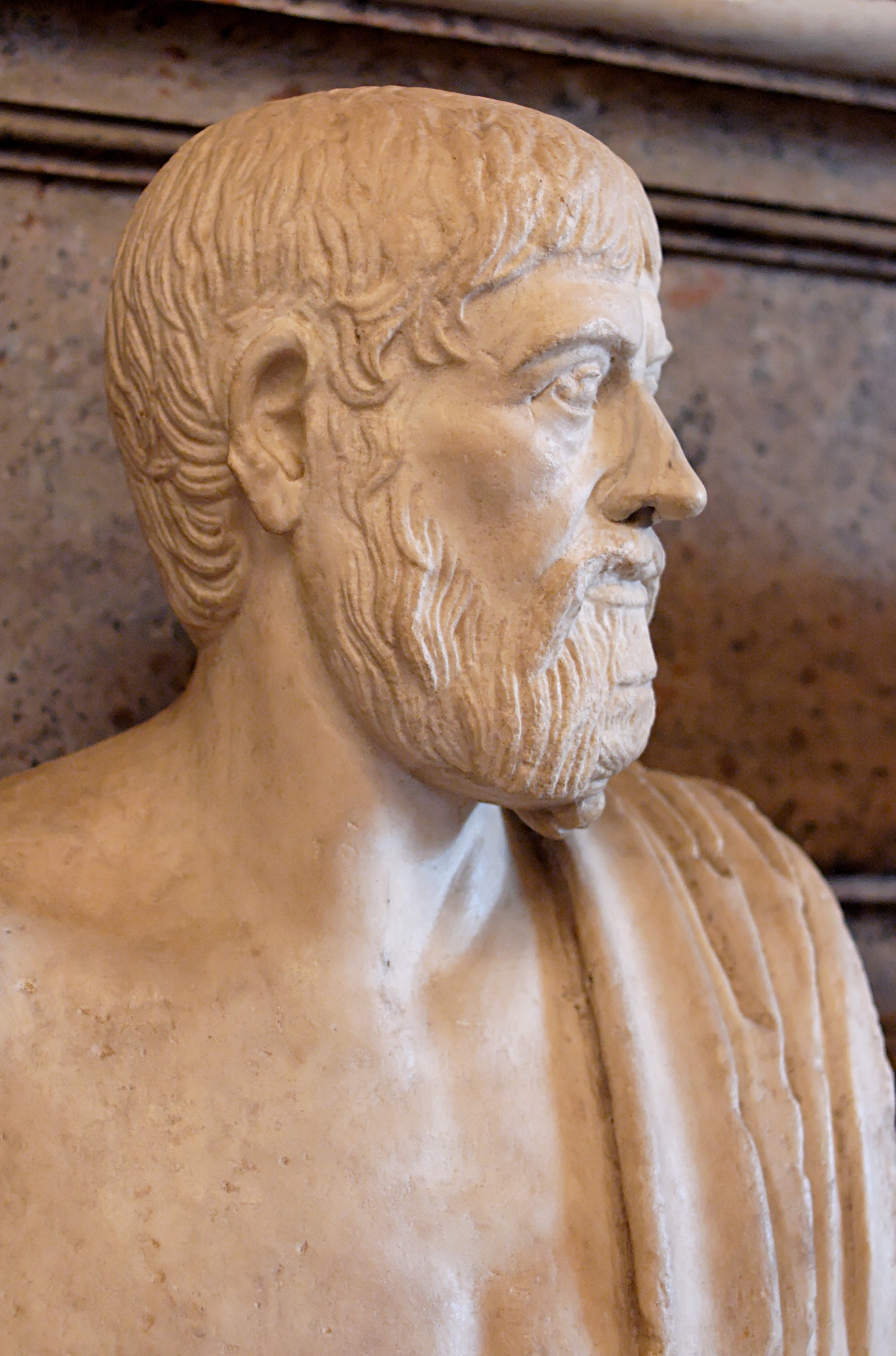
The erudite Joseph Addison had read more widely than these Latin writers and in a piece for The Spectator in 1712 showed off his knowledge of Greek: 'my compositions on gardening are altogether after the Pindarick manner, and run into the beautiful wildness of nature, without affecting the nicer elegancies of art.'  According to Richardson, 'Pindar's verse mingles an admiration of the grandeur of raw nature with an ability to complement its changefulness and variety through elegant expression.'  This makes him sound like an interesting wilderness poet, although as with Persius there is no direct writing on landscape in his Odes.  Addison was probably thinking more about the way Pindar wrote. Horace, for example, compared Pindar's writing to a wild landscape: 'a river bursts its banks and rushes down a mountain with uncontrollable momentum, rain-saturated, churning, chanting thunder – there you have Pindar's style...'

Pindar (Roman copy after a Greek original of the 5th century BCE)

Theoryscapes


Landscape Theory (2008), edited by Rachael Ziady DeLue and James Elkins, is Volume Six in the 'Art Seminar' series, which addresses current issues in writing about art through roundtable discussions and invited contributions.  It is a really rich and readable anthology of writing about landscape; the theory doesn't get too heavy despite the forbidding cover - an empty seminar table rather than a picturesque landscape.  Interestingly, one contributor to the book, Jill H. Casid, noticed the way that the general preface to the whole series, written by Elkins, is actually 'implicated in the discourse of landscape with its rehearsal of what we might call the metaphorics of theoryscaping.  Current writing on the visual arts is compared to a "trackless thicket" in order to assert that it is "not a wilderness."  Instead, visual graphs (that are given the look of geological formations [they are 3D area charts]) convert "theory in art history" into a "landscape of interpretive strategies" through which the series offers a well-blazed and navigable trail.'

I thought it might be interesting here to try to summarise briefly the seminar discussion (70 pages in the book!) and in doing so add links to some relevant earlier posts on this blog.  The event took place in June 2006 at the Burren College of Art in Ireland and brought together art history, geography and landscape architecture academics (plus an independent scholar - Rebecca Solnit).  James Elkins opened the discussion by remarking that in the years since the original publication of Denis Cosgrove's influential Social Formation and Symbolic Landscape (1984), it has become increasingly possible to move beyond the idea of landscape-as-ideology. There was general agreement to this, including from Cosgrove himself, who nonetheless recalled that his book had been a reaction against two then-prevalent ways of thinking about landscape: as the romantic, aesthetic response to nature or as more scientific, geographical analysis. Elkins introduced a third notion, landscape as a work of physical production, leading to discussion of the etymology of 'landscape' - the OED defines it in relation to art but another root is the Old English 'landscipe', which concerns the shaping of a place.  A fourth version of landscape, the representation of space and time ('landscope') provoked discussion of the priviledged position of the observer in art history and those 'timeless' landscapes without figures, like Ansel Adams' photographs of Yosemite.

The problems of separation - either by framing a view or more generally from the unbridgable distance between observer and those actively shaping the landscape - led to the first mention of phenomenology as a way of thinking more about our experience of landscape. Jessica Dubow talked about the recent turn to phenomenology in cultural geography, which has moved beyond the study of images (or images-as-texts) to a more direct encounter where the subject is inside the landscape. There was some further discussion of ideology and whether it is helpful to think of 'landscapes' in the postmodern global cultural economy (Arjun Appadurai's notions of 'finance-scapes', 'techno-scapes' and so on).  But the last words of the morning session were Denis Cosgrove's, concluding that a focus on virtual spaces 'raises issues in relation to the materiality of landscape that phenomenology emphasizes.'

The conversation recommenced with discussion of the extent to which landscape became less central to twentieth century art.  David Hays referred to a different trend in landscape architecture, where art has become less influential: ecological concerns now dominate and 'art' is seen as almost a dirty word (although there are exceptions -  Anne Whiston Spirn mentioned Martha Schwartz's Splice Garden). The discussion then turned to maps, panoramas and their military origins and from map-making to the distinction between cartography, the conceptual visualisation of the landscape, and chorography, a more sensory, descriptive approach.  But in the midst of this I was struck by Denis Cosgrove's comment that 'mapping removes us a little from the suffocating embrace of ecology when thinking about the natural world and places and our relations to them.'  Trenchant stuff - just as well no ecocritics had been invited!  The absence of any ecological discussion in this seminar was interesting to me (since this blog has always focused on forms of landscape art, rather than environmental art) but disappointing too, given the natural expectation that there would be cutting edge theoretical thinking in this area.

At this point in the seminar James Elkins intervened to change the subject and ask whether it is possible to imagine landscapes outside of their representation in art.  The subsequent discussion touched on the way tourists see Yosemite through the lens of Muybridge and Adams, partly because the park's infrastructure leads them to specific viewpoints. These photographs are social acts - people rarely take a view without posing in front of it - but such views are still based (for Elkins) on the late-Romantic Western tradition of painting and photography. This view has been put forward in Joseph Leo Koerner's writings on Friedrich and indeed one participant, Michael Newman, suggested that Friedrich's hyperreal style clearly pre-figures our contemporary digital landscapes. I was surprised there wasn't more exploration at this point of different perspectives, although participants did mention the Silent Traveller books, written in England by Chiang Yee, and the landscape architect Nicholas Brown, who 'walks somewhat in the spirit of Richard Long.'  But time was obviously running short and after a few more questions from the audience Elkins closed the seminar, inviting participants to head out for a hike 'in what we persist in pretending is the actual landscape'.
The Burren landscape

Climbing Mount Kagu

Among the 4,500 poems which make up the Manyōshū ('Collection of Ten Thousand Leaves'), there is one attributed to the Emperor Jomei (593-641), called 'Climbing Mount Kagu'.  It describes the view from the mountain down towards the land of Yamato: 'Over the wide plain the smoke-wreaths rise and rise, Over the wide lake the gulls are on the wing...'  This translation, like others I have seen, omits the poem's descriptive epithet for Yamato, 'island of the dragonfly'.  The phrase refers to the way a dragonfly's tail touches its mouth to form a ring, like the circle of mountains round the plain of Yamato.  It is an example of a pillow-word (makura kotoba), which Geoffrey Bownas calls in his introduction to The Penguin Book of Japanese Verse (1964) 'a qualifier describing, by tradition, certain nouns or concepts.'  Among other examples connected with actual places are 'rock running' for Ômi' (from the image of water gushing over rocks) and 'spring mist' used to modify Kasuga. Pillow-words are often likened to the Homeric stock epithet, although most of those describe people (ox-eyed Hera, swift-footed Achilles, laughter-loving Aphrodite) rather than places (Mycenae rich in gold).  According to Bownas the comparison fails to do full justice to the essence and purpose of pillow-words, whose 'alliterative or assonantal ring' ensure that the reader pauses on the word being qualified.  'Further, since many of the head-words are place names, it is argued that part of the purpose of the pillow-word in its early use in primitive society was to act as a talisman for the good fortune of the place in question.' He goes on to provide his own example poem in the form of a donnish joke about Oxford's 'Heaven-preserve-it Western By-Pass'.

 Pillow shot from Tokyo Story (Ozu-San.com)

The phrase 'pillow shot' has come to be used to describe the short transitional images of landscapes, interiors and objects that are such a distinctive feature of Yasujiro Ozu's cinema.  There are many examples on the excellent Ozu-San website and a montage on Youtube (embedded below).  The first scene of my favourite Ozu film, Tokyo Story (1953), shows an old couple, the Hirayamas, packing for their trip to Tokyo.  The second takes place in the house belonging to their son, a doctor in the capital.  We do not see the journey itself - instead the scenes are intercut with three pillow shots showing smokestacks (see above), a railway crossing and the sign outside their son's office.  These are more than just establishing shots - as David Desser writes in his handbook to the film, 'careful examination of the exterior shots in the rest of the film reveals that the smokestacks and train station are, in fact spaces "connected" to Dr. Hirayama's, but nothing so indicates that at the start.'  This connection resembles the way that particular words in early Japanese poetry were given associative pillow-words.    


The ear/OAR label specialise in avant garde sounds and environmental recordings; landscape-related examples include Kiyoshi Mizutani's Scenery Of The Border, Francisco López's Trilogy of the Americas and the Phonography series.  In 2007 they released a compilation of music inspired by Ozu's pillow-shots.  A review in The Wire concluded that 'despite the range of idioms on display, from delicate electroacoustic tapestries (Bernhard Gunter) and meditative drones (Keith Berry) to bucolic field recordings (Kiyoshi Mizutani) and frequent uses of silence (almost all), each perfectly serves their respective image. Highlights include Steve Roden's beautiful pairing of chiming guitar and hushed percussive patterns; label owner Dale Lloyd's gently shifting gamelan shapes; and Taku Sugimoto's 'Tengu In Linguistics', where he drops six strident piano notes into a reductive vacuum, reflecting another of Ozu's themes, the eschewal of action in favour of the contemplation of the surrounding space.'  Yasujiro Ozu - Hitokomakura followed an earlier compilation dedicated to Andrey Tarkovsky.  The sequence was completed last year with a tribute to Michelangelo Antonioni.