Showing posts with label Claude Lorrain. Show all posts

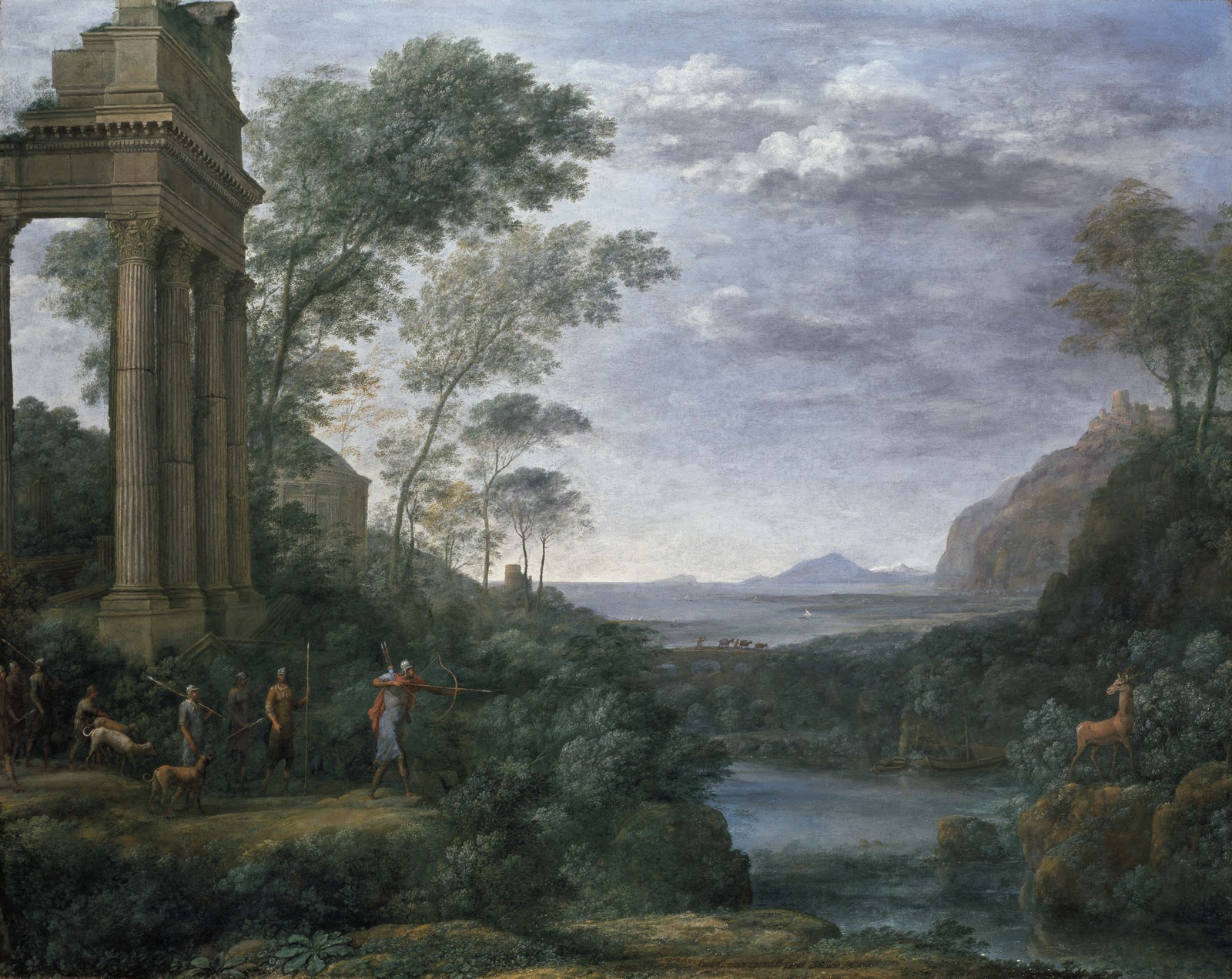
Landscape with Ascanius shooting the Stag of Sylvia

The Ashmolean Museum's exhibition Claude: The Enchanted Landscape, which I looked round yesterday, provides a good opportunity to compare the artist's drawings and sketches.  A preparatory sketch for Claude's last painting, Ascanius shooting the Stag of Sylvia, shows the foreground figures standing out from their background and Ascanius (the son of Aeneas) just left of centre.  Trees, portico and people are all on a more realistic, less monumental scale.  In the painting, as Martin Sonnabend and Jon Whiteley point out in the catalogue, 'everything has been suffused with an air of fantasy.  The hunters are impossibly elongated - Ascanius, in particular, is absurdly top-heavy - but even they are overwhelmed by the landscape, lit by a silvery sky, which arches over them and recedes far back into the blue, snow-capped hills.'

Claude Lorrain, Ascanius shooting the Stag of Sylvia, 1682

I was curious to compare the two figures of Ascanius directly and so had a play on Photoshop, as you can see below.  It would seem facile to say this shows Claude could have painted more naturalistic figures if he'd wanted to, but the point is worthwhile because contemporaries criticised this aspect of his painting and Claude himself reportedly joked that when he sold his landscapes he threw the figures in for nothing.  Of course the figures in Ascanius shooting the Stag of Sylvia can't be seen in isolation (or cut out from their setting); the painting's harmonius colours and soaring forms combine to convey a legendary time and place, dreamed from the poetry of Virgil.  Goethe summed up the nature of landscapes like this in 1829, when he said that Claude's paintings 'possess the highest truth, but no trace of reality.' 

Landscape with a Natural Arch and Waterfall

Claude Lorrain, Perseus and the Discovery of Coral, c1671
(preparatory drawing for the Holkham Hall painting,
Metropolitan Museum of Art)

In Helen Langdon's catalogue for last year's Salvator Rosa exhibition she refers in her notes on his painting Landscape with a Natural Arch and Waterfall to the art history of a specific landform, the rocky arch.  These were painted more frequently after 1626, when an ancient Roman landscape painting with a rocky arch was discovered in a nymphaeum near the Barberini palace.  It was a favourite motif of Rosa's - either inland, as in the Detroit Finding of Moses, or by the sea, as in the Doria Pamphilj's Coastal Scene. In the Palazzo Pitti's Landscape with a Bridge the form of the rocky arch is echoed below by the arches of a crumbling bridge.  Peering at small online images of picturesque landscapes, as I have just been doing, it is sometimes hard to distinguish ruined architecture from natural rock formations.  Both feature in the work of Northern artists working in Italy in the seventeenth century, like Paul Bril and Jan Breughel I. Rosa was probably influenced by his fellow Neapolitan, Filippo Napoletano, who included the rocky arch in his frescoes for the Palazzo Rospigliosi Pallavicini, and by Claude Lorrain who 'worked numerous variations on it.'  It would be fascinating to write a proper history of rock arches in art, covering these imaginary scenes and later works where artists sought to paint or photgraph real examples, like the cliffs at Etretat.  We have recently had cultural histories of mountains, forests etc. and now I think it is time to focus on particular geographical features... 


Gustave Courbet, La falaise d'Étretat après l'orage, 1870
Source: Wikimedia Commons