Showing posts with label John Milton. Show all posts

Apocalypse

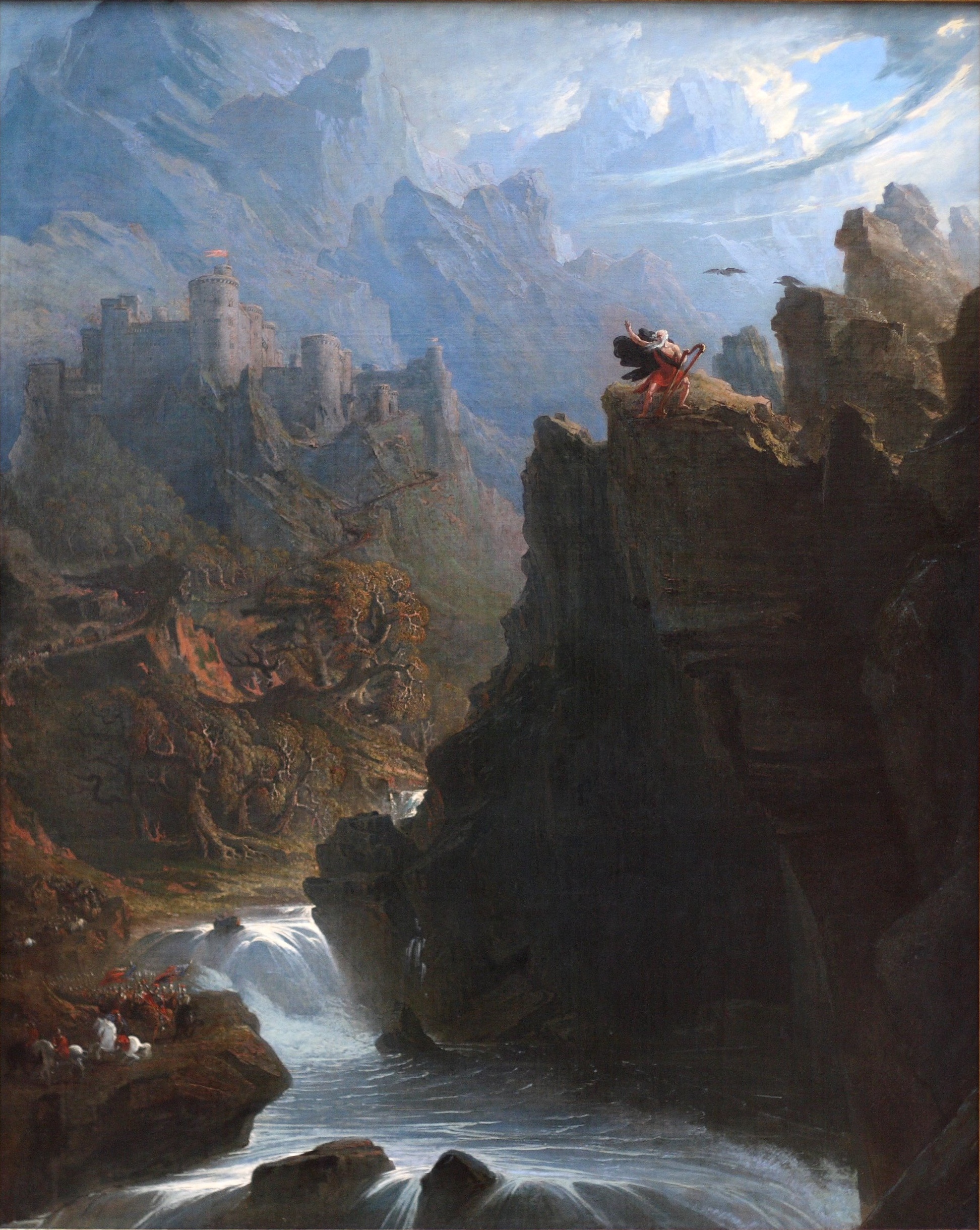
John Martin, The Bard, c1817

As the Tate Britain exhibition John Martin: Apocalypse comes to the end of its run, it would be interesting to know how well it has done.  There was talk beforehand of the way that Martin's critical reputation has risen and that his spectacular paintings should appeal in a world of 'proliferating IMAX cinemas and giant plasmas' (Ian Christie in Tate Etc. magazine) and contemporary photography framed on a Sublime scale - Edward Burtynsky, Florian Maier-Aichen, Andreas Gursky (Jonathan Griffin also in Tate Etc.)  The Tate's familiar Last Judgement Triptych was accompanied by a new 'theatrical display' intended to evoke the way these paintings were seen around the world in the late nineteenth century.  Looking round the exhibition I found it easy to see why John Martin's work has been mocked - "huge, queer and tawdry" was the verdict of William Makepeace Thackeray.  Martin's shortcomings are more evident when you see the paintings up close: The Bard for example often gets reproduced in books about Romanticism but I'd not previously been able to see how unconvincing some of its details are - Edward I's army a line of little tin soldiers trailing all the way back to the castle gate.  Yet there's still something awesome about these blockbuster paintings (at least that's what the adolescent Chris Foss fan I used to be was telling me) and the exhibition was also fascinating for the way it highlighted Martin's less well known activities - as a decorator of plates, an illustrator of prehistoric creatures (Gideon Mantell's The Wonders of Geology) and a painter of modest topographical water colours, like some views of Richmond Park where, like Edmund Spenser in Ireland, he had an oak tree named after him (how many writers and artists are commemorated in this way I wonder?)

Perhaps the most surprising exhibits were two examples of his schemes to improve the city of London.  The first, which might have been drawn by a 1970s land artist or a 1990s psychogeographer, was his plan for a London Connecting Railway - a beautiful curving form superimposed on a map, like the outline of an octopus.   The other was a drawing of a sewer housed in a new Thames embankment, stretching from 'the Ranelagh Outlet to the Engine Station': a proposal considered seriously at the time but easy to view as one more facet of Martin's capacity to dream up imaginary cities. (It made me think of today's urban explorers, uncovering tunnels like these and scaling buildings to view the city below from a John Martin perspective.)  An excellent article in The Guardian by the John Martin expert William Feaver mentions these engineering projects and claims that Martin 'was ecologically prophetic. In his 1833 A Plan for Improving the Air and Water of the Metropolis he raised an issue such as had been dismissed by the scoffers who ignored divine warnings and were swept away in Noah's flood: "Is it not probable that a too ignorant waste of manure has caused the richest and most fertile countries such as Egypt, Assyria, the Holy Land, the South of Italy etc to become barren as they now are?"'

John Martin, Pandemonium, 1841

The Valley of the Shadow of Death

Jonathan Tyers, the owner of Vauxhall Pleasure Gardens, had his own private estate at Denbies in Surrey.  There he named an 8-acre woodland 'Il Penseroso' after Milton's poem - perhaps, as Tim Richardson says in his book The Arcadian Friends, Tyers 'viewed Vauxhall Gardens as its equivalent, the more jocund L'Allegro' and the melancholy woodland as 'a kind of penance for the jolly hedonism of Vauxhall.'  In this wooded part of the garden there was a hermitage called the Temple of Death which contained, in addition to a memorial to garden designer Lord Petre, a model of a white raven and a clock that chimed every minute, to remind visitors of the transience of life.  Black leather-bound copies of Edward Young's Night Thoughts and Robert Blair's The Grave were available for perusal on a table.  Beyond the hermitage was a gateway with posts made from upright coffins, 'its arch surmounted by a pair of human skulls (reputedly real - one belonging to a highwayman, the other a prostitute's)'.  This was the entrance to the Valley of the Shadow of Death.  Here the two artists Tyers had previously employed at Vauxhall were asked to decorate the interior of a temple.  Either side of an allegorical statue by Louis-François Roubiliac were paintings by Francis Hayman: The Death of a Christian (peaceful and accompanied by an angel) and The Death of an Unbeliever (about to be speared by a leering skeleton).  Richardson concludes that 'any visitors who arrived thinking they might have an amusing time with the happy-go-lucky proprietor of Vauxhall Gardens were in for a disappointment.'

William Blake, illustration intended for the 1805
publication of Blair's poem 'The Grave'

Fore-edge painting of the Pont a la Carraca

Specimens of the early English poets, 1790, bound by Edwards of Halifax. 
Fore-edge painting of the house of Sir Thomas Claverings, Oxwell Park, Northumberland

The Boston Public Library has a most excellent online collection of fore-edge book paintings.  Anne C. Bromer's short essay there explains the development of this art form after the sixteenth century, when 'a Venetian artist, Cesare Vecellio, devised a way to enhance the beauty of a book by painting on its edges. The images, mostly portraits, were easily viewed when the covers of the book were closed. A century later in England, Samuel Mearne, a bookbinder to the royal family, developed the art of the “disappearing painting” on the fore-edge of a book. ... In the late eighteenth and early nineteenth centuries, fore-edge painting reached its height in England. The famous bookbinding firm, which is always referred to with “the territorial suffix” Edwards of Halifax, was responsible for this surge of interest. Artists were employed to paint landscape scenes with country estates on the fore-edges of books, which were then handsomely bound in painted vellum covers or in exotic leather bindings.'

The Poetical Works of Thomas Moore, 1865
Fore-edge painting of the Pont a la Carraca, Florence

The river scene in Florence above is actually one of two landscapes on this edition of Thomas Moore's poems.  It is an example of a double fore-edge - when the pages are bent to the right instead of the left, a different scene appears, showing Enniscorthy in Wexford.  Sometimes fore-edge landscapes were directly related to the book's contents, like the edition of Oberon below, or William Rae Wilson's Travels in the Holy Land, Egypt &c. &c. (1831), volume 1 of which shows a view of Joppa and volume 2 a view of Corfu.  Others seem to have no obvious link - a four volume edition of Homer features views of Eton from the river, Hampton Court Place, Oystermouth Castle and the city of Bath.

Oberon : a poem, from the German of Wieland by William Sotheby, 1798.
Fore-edge painting of a scene from the book - "Go hence to Bagdad'"

I've written here before about our fascination with the 'homes and haunts' of writers, in books like Gilbert Highet's Poets in a Landscape and Edward Thomas's The Literary Pilgrim in EnglandLooking through the Boston Public Library collection you can see how often fore-edge paintings provided picturesque views of the author's home.  Examples include Robert Burns' cottage, Alexander Pope's villa, William Cowper's house at Weston and the childhood home of John Wesley to accompany A collection of Hymns, for the use of the people called Methodists (1825).  Mary Brunton, author of Emmeline, was born on the Island of Burray, giving the bookbinders scope for a view of blue-grey mountains and sea.  Milton's birthplace in Bread Street, London, may have been harder to idealise, but the school he attended, St Paul's, provided a splendid vista, while other editions of his work featured a view of London Bridge and the cottage at Chalfont St Giles to which he retired during the Great Plague of London.